Metaphysics


white-flowersFor the past several days, I’ve been mulling an op-ed piece that ran in last Friday’s Wall Street Journal titled If I Don’t See It, It’s Not There.

The piece is written by Steve Salerno, a former Men’s Health editor who wrote a book in 2005 about how the self-help industry is not really all that helpful.

Salerno’s target this time is the “talking heads” who contributed to the DVD version of The Secret, which — in case you spent 2007 dozing in the ol’ armchair — was a blockbuster addition in the robust tradition of “positive thinking” literature we Americans have been devouring en masse since the days of Dale Carnegie and Norman Vincent Peale.

Salerno takes The Secret crowd to task for the way they’re reacting to the recession — which, truth to tell, isn’t always very, erm, nuanced. For example, he includes a quote from one Nan Akasha who says she chooses not to believe in the recession. The implication being that one can make unpleasantness go away by squeezing one’s eyes shut or something.

But here’s the thing. As seductive as Salerno’s mockery is, open that same paper’s Tuesday May 5 edition and on page A12 there’s a piece about the latest research on quantum physics. The research confirms what quantum physicists have been theorizing for quite some time: first, that particles can somehow stay connected with one another across space (non-locality); and second, that the act of observation is itself somehow involved in defining a quantum particle’s characteristics.

Some people would dismiss this as pertaining only to sub-atomic phenomena. In the big-particle world of paychecks and golf balls and stubbed toes (they would say) quantum spookiness doesn’t apply.

But what if our minds operate on a quantum level?

What if our thoughts are sensitive to quantum-level energy patterns?

What if thought itself is a quantum-level activity?

jesterEven more radical: what if our minds function in some respects like a lens that causes quantum-level particles to resolve and literally come into being as a prelude to perceiving them en aggregate with our physical senses?

And, furthermore, what if the demarcation between our minds, as individuals, isn’t as well-defined as we might suppose?

Think about it. The electromagnetic waves emitting from my brain don’t stop at the edge of my skull.

Is it possible that your brain might start resonating with mine if we stood near each other, or vice versa?

And if so, might there be on a collective level a kind of mass entrainment involving the synchronization of our individual energy fields, that might in turn exert some sort of effect on what we describe as physical phenomenon?

If so, then maybe recessions and pandemics — as well as prosperity and cures — really are influenced by our minds. Not created — this isn’t cartoon magic — but resolved out of a kind of soupy pool of potential events or phenomenon — then fixed into place because we take collective notice.

Personally, I suspect something like this does occur. But its mechanics are not only too subtle to be discerned by our physical senses, they are also too subtle to be described, let alone manipulated in terms as childish as “if I don’t believe in the recession, it won’t have happened.”

Salerno’s mockery isn’t entirely misplaced. I’m reminded of a funeral I attended not long ago, where the preacher assured us that the deceased was sitting on a cloud, watching us. Yes, he meant that literally. Presumably Salerno would guffaw as loudly at that solemn Christian as he does at Bob Procter and Joe Vitale.

Which is too bad, because he’s missing something important — something that might mark a turning point for mankind. Quantum physics attempts to peer into a dimension where space and time don’t exist in the way our senses would conscribe them — where death isn’t really death, and where life really is a kind of dream . . . it would be a shame to miss it just because, stated simplistically, it sounds too fantastic to be true.

Deepak Chopra is trying his hand at political commentary. With a metaphysical gloss, of course. Unfortunately he falls flat on his face. I’m kinda sorry about it, too, I thought he was sharper than this.

Palin’s pluck has been admired, and her forthrightness, but her real appeal goes deeper.

She is the reverse of Barack Obama, in essence his shadow, deriding his idealism and exhorting people to obey their worst impulses. In psychological terms the shadow is that part of the psyche that hides out of sight, countering our aspirations, virtue, and vision with qualities we are ashamed to face: anger, fear, revenge, violence, selfishness, and suspicion of “the other.” For millions of Americans, Obama triggers those feelings, but they don’t want to express them. He is calling for us to reach for our higher selves, and frankly, that stirs up hidden reactions of an unsavory kind.

Huh?

You’ve missed the mark, Deepak. Way missed. Shadows are psychological projections, not objective fact: Obama is as much Palin’s shadow as she is his.

Holding Palin up as somehow objectively negative–as objectively embodying “anger, fear, revenge, violence, selfishness, and suspicion,” therefore, does nothing to raise the discourse spiritually. It just feeds into the already half-psychotic partisan frenzy that is distracting so many people from the things that really matter. Roman-style Games, only played out in conversation instead of the arena.

Chopra makes a quick aside to make sure we have no cause to question his own virtue . . .

(Just to be perfectly clear, I am not making a verbal play out of the fact that Sen. Obama is black. The shadow is a metaphor widely in use before his arrival on the scene.)

Got it. You’re not a racist. Check.

He’s just looking out for our greater good:

I recognize that psychological analysis of politics is usually not welcome by the public, but I believe such a perspective can be helpful here to understand Palin’s message.

Nope, it’s not the least bit helpful, sorry. It’s a justification for some of the worst impulses poisoning our contemporary political discourse, all dressed up in high-falutin’ pseudo psychology speak, is what it is.

You want to add perspective, Deepak? How about this: we need to start accepting that people on both sides of the political spectrum are equally privy to goodness and understanding and love. That Palin can legitimately embody loyalty, bravery, duty, grace, confidence, tradition, selflessness, strength, optimism — virtues every bit as lofty and admirable as those Chopra projects onto Obama.

Chopra sells books because people believe he has advanced his understanding to a point where he has something to share. That only works if he’s actually, like, “advanced.” This column just makes him look like a Hollywoodized mock-up of “advanced.” Silly man.

More evidence that our rational self isn’t really the self that’s in charge: as described in a piece by Robert Lee Hotz in Friday’s Wall Street Journal, research suggests that when we “decide” to do something, we’re not really deciding. What we’re really doing is becoming aware of a decision that’s already been made.

In one study, researchers led by John-Dylan Haynes in Berlin monitored “neural currents” in volunteers’ brains (using magnetic resonance imaging) as the volunteers pushed buttons using either their left and right hands. The researchers discovered that they could predict which hand the subjects would use by the neural activity that preceded the button-pushing.

The foundation of this research is the work of
the late Benjamin Libet, who came to similar conclusions
.

One way a lot of people respond to these sort of findings is to question whether humans have “free will.” But if you accept the assumption that there is an aspect of the Self that operates more or less independently of the Self with which we generally identify, none of this is the least bit surprising. Of course “Self 2″ causes ripples in the brain’s electromagnetic field. They just happen to be ripples beneath the surface of conscious awareness. It doesn’t mean we don’t have “free will.” It may, however, mean that “free will” is a meaningless concept.

In the WSJ piece, Hotz goes on to report other research that suggests that we make better “consumer decisions” (e.g. what car to buy) when we’re distracted.

See? It’s not just about swinging a golf club ;-)

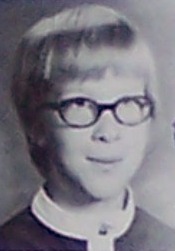
me sixth grade

At some point in fifth grade, I noticed the blackboard in Mrs. Marshman’s math class was blurry. I mentioned it to my parents, and within a few weeks had been fitted with my first pair of glasses.

I didn’t submit to the experience wholeheartedly, by any means. Most troubling was the sense that I was now damaged in some way. Poor eyesight is a mild disability for sure, generally more a nuisance than a crippler. Still, the finality of it weighed on me. It also complicated things. My eyeglass lenses were constantly in need of cleaning, the frames would get knocked about and no longer fit, and then, of course, came puberty, and to my other insecurities came the added burden of a reputation for braini-slash-nerdiness — of which my glasses were an obvious sign.

college photoThe body is always in a state of flux, of course, and once pointed in the direction of poor vision dutifully explores that trajectory; the silver lining was that as my eyesight worsened I swapped the hornrims for gold wire rims, and later contact lenses. Not quite so homely.

But I still hated them.

Then, in the late 1980s, I learned about William Bates, an early 20th Century physician who had made the astonishing claim that poor eyesight is learned — and can be unlearned.

I read his book, tossed my contacts aside, and began muddling about the world without my visual crutch.

I was encouraged at first. With my eyes freed to function more naturally, my vision improved quite a bit right away; my right eye (the “weaker” of the two) went from 20/180 to 20/80 or so.

But 20/20 vision eluded me. I could induce it for short periods — I’ve passed vision tests, twice, for my driver’s license — but much of the time my world was still blurry. I didn’t put my glasses back on. But sometimes I wondered if the received wisdom wasn’t correct, after all. It seemed that perhaps poor eyesight is inescapable, a curse bestowed by our genes or the modern necessity of being tethered to close-up work, reading, computers.

Now I know differently.

The clues I needed were in another book, Relearning to See, by Thomas Quackenbush. I won’t bore you with the minutiae of my discovery, but the upshot is that I needed to relax and stop trying to see. By trying to see, I was distorting either the shape or the alignment of my eyeballs. When I relax, breath, and stop trying to see, the world around clears.

This isn’t a purely physical change. On the contrary, Candace Pert is right on when she says the body is the subconscious mind. Granted, straining to see has a measurable effect on the physical body (this image

myopia

is one Quackenbush reprinted from Bates’ Perfect Sight Without Glasses; the woman had perfect vision at the time the leftmost photo was taken. In the middle photo she has myopia — see how her eyes look different? And on the right, she’s furrowing her brow as she tries to see) — but it is first and foremost a condition of being. Put another way: my vision began to blur when I was a child not because my eyes were failing but because as I transitioned from early childhood into social awareness — when I began valuing how others viewed me — a kind of habitual anxiety that defined my relationship to myself hardened into fact. Little wonder the world around me went dim.

When I relax, breath, and stop trying to see, I feel something that affects more than my eyes. It’s like sinking back into a comfortable chair, a state of being in which I am letting go instead of struggling. The clarity of my vision is ancillary: a function of a different vantage point rather than a different way to hold the muscles of my eyes.

Quackenbush touches on this as well in his book, writing:

The individual with blurred vision is interfering with the normal, relaxed way of using the mind and body.

Plenty has been said about the way we modern folk are so stressed; how we react to non-physical stimuli with the same fight/flight response our forebears depended upon to escape saber toothed tigers. But how many of us realize that this response literally distorts our experience? It’s a perversion of our ability to think abstractly: we wrap ourselves in a kind of continual low-grade nightmare, little realizing that our anxiety defines what we can touch and know.

“Cultivate a habit of relaxation.” It’s the first New Year’s resolution on my list, because I’ve begun to understand that everything else flows from it . . .

Technorati Tags: , ,

I expected something different from Candace Pert’s latest book, Everything You Need to Know to Feel Go(o)d. For starters, the title’s a bit of a bait to the text’s switch. You aren’t going to find that promised Everything here. In fact, you aren’t going to find much, if any self helpy advicey stuff.

Pert cover

What you’re going to find, instead, are two other books. The one that takes up the most room is an autobiographical account of Pert’s efforts to deal with personal “issues” she’s realized have sabotaged her efforts to realize her vision of an AIDS cure. Pert and her husband, Michael Ruff, have pioneered research on peptides that block the receptors that permit the AIDS virus to enter cells (Pert’s a recognized experts in peptides and peptide receptors; as a graduate student in the 1970s, she proved the existence of opiate receptors). The original research they did was funded by the National Institute of Health; the two have been fighting for years, now, to wrest control of it from others who, for various reasons, have either quashed it or tried to leverage it for other, less compelling causes. This content is no doubt of interest to Pert’s fans, and will no doubt be a useful model to people struggling through parallel difficulties, but it’s not what I was looking for when I bought the book.

The other book got me excited. Unfortunately, it’s on the thin side: bits scattered here and there, primarily as summaries of presentations Pert has given over the last couple of years during her many public appearances.

The first bit peeks out at us right away, when Pert tells us she believes in something even more radical than “mind over matter. ” She believes that “mind becomes matter” — and that there is “real science” to support that assertion.

By sorting out the autobiographical diary-of-a-seeker stuff, one is able to find hints of that science. A big piece of it is that James Oschman (with whom Pert has collaborated on another book) has proposed “a physical structure in the body composed primarily of collagenous fibers, the kind that make up your connective tissue.” This structure, which Oschman calls “the matrix,” connects and penetrates every cell of the body, “a new understanding that flies in the face of the classical view of cells as empty little bags whose interior isn’t hooked up to existing structures.”

The significance of this structure, Pert writes, is that it’s “actually a semiconductor, a substance capable of supporting fast-paced, electrical activity . . . [I]n many ways, it’s like a giant liquid crystal.”

Apparently peptides — some of which we recognize as neurotransmitters that affect mood, e.g. serotonin — cause our cells to give off electrical signals which are transmitted by/across this structure. In other words, when we resonate with an emotion, we really are resonating. Furthermore, others around us can be affected by this resonance, rather like a tuning fork, rung, can cause another tuning fork to vibrate. You know the old quandary about how could a flock of birds sitting in a tree suddenly take off at once, as if they were one organism? Well, based on Pert seems to be saying, they are one organism: they are matrices within a greater matrix . As are the crowds of people at a concert or sporting event or political rally or church service.

Our body can also store charges — i.e., past emotional charges can be recorded by or imprinted in our bodies, causing us to essentially “lock in” to certain habitual ways of feeling or responding emotionally.

There are some other bits as well about the frequencies of music, color, and brain waves sharing identical wavelengths. Put it together and there’s the suggestion that, for example, our emotional response to music can be attributed the way the tones stimulate our cells’ neurotransmitter receptors. Wild. Wish there was more of that kind of stuff in the book.

Technorati Tags: ,

Can’t solve a problem on the level at which it were wrought.

So. Anyway. This is kind of cool:

If human speech is recorded and played backwards, mixed amongst the gibberish at regular intervals can be heard very clear statements. These statements usually appear in short sentence form and are nearly always related to the forward speech. It appears constantly throughout language, so much so in fact, that it is believed to be a natural part of our speech processes.

The webpage has audio clips if you want to listen for yourself. Some are pretty amazing, especially the ones that aren’t taken from famous audio recordings (scroll down to the list at the bottom of this page). By which I mean, this isn’t muddled audio inkblot stuff — it really sounds like clearly spoken words.

Either a huge hoax or our subconscious minds are continuously encoding “secret” messages in our speech.

From the FAQ page, the phenomenon was discovered by one David Oates “after his tape deck became damaged and only played tapes backwards” and that we embed these sort of messages every 5-15 seconds as we talk.

Wild.

Technorati Tags:

A lot has been said about writing as an act of creation, so much so that we’ve probably become more jaded than we realize. Articulating experience via language is, after all, so simple a child can do it. And self-proclaimed Writers are ubiquitous. You’ve probably heard, as I have, that some 80 percent of Americans think they’ve got what it takes to be a writer. Those of us who take writing a bit more seriously are easily creeped out by such suggestions. “Keep it to yourself,” we mutter under our breath. “You’re turning my stomach. As is your prose.”

Yet even bad writing thrills the writer as it erupts. Why? Why? Why do so many of us feel a compulsion to articulate experience?

Perhaps because it represents an even more fundamental compulsion. Here’s from Jung’s memoir, something he wrote after watching massive herds of animals grazing on a savannah in Africa:

. . . the cosmic meaning of consciousness became overwhelmingly clear to me. “What nature leaves imperfect, the art perfects,” say the alchemists. Man, I, in an invisible act of creation put the stamp of perfection on the world by giving it objective existence. This act we usually ascribe to the Creator alone, without considering that in so doing we view life as a machine calculated down to the last detail, which, along with the human psyche, runs on senselessly, obeying foreknown and predetermined rules. In such a cheerless clockwork fantasy there is no drama of man, world, and God; there is no “new day” leading to “new shores,” but only the dreariness of calculated processes . . . man is indispensable for the completion of creation . . . in fact, he himself is the second creator of the world, who alone has given to the world its objective existence — without which, unheard, unseen, silently eating, giving birth, dying, heads nodding through hundreds of millions of years, it would have gone on in the profoundest night of non-being down to its unknown end. Human consciousness created objective existence and meaning, and man found his indispensable place in the great process of being.

Writing, as an act, embodies the act of secondary creation. It objectifies existence, literally: all at once that which we know to have created is visible in three dimensions.

It doesn’t matter what kind of writing it is, whether it’s a blog post, or a novel, or an email to a friend, or a weepy entry in a private journal. It is a relief to do it. No matter how nonsensical the act itself make sense of our experience.

The mystery of words is that they are also, however, unruly creatures. You may think they are tools at your command, but they are also messengers. They dwell on the cusp between objective and unconscious reality; this is why they can have double meanings, or express sometimes things that we claim we didn’t intend them to express.

That same quality also makes them a delight, of course, which is why gaining a bit of skill as a writer makes the act even more pleasurable — the act of secondary creation, performed with some inkling of awareness, or rendered artfully enough that in partaking of it we begin to waken, even slightly — it’s a heady thing — it is why we recognize that some writing as Art.

Take love, for instance, plenty of examples here. A mystic will tell you that if you reach the leafy crown of the magical beanstalk ;-) you’ll discover all love is really The One Love. But down here in the world of foolishness and poverty and dirt and beans we have, instead, this sort of love and that sort of love. Then come along the secondary creators who play with the word. Ray Charles secularizes the gospel song “Jesus is All the World to Me” and in so doing casts words of Christian love into the service of Romantic love. Sixty years later, Alison Krauss goes back the other way, recording a song about Christian love, only the object of her love is hidden, slyly, within the vernacular of romantic pop:

Am I a fool for hanging on?
Would I be a fool to be long gone?
When is daylight going to dawn
On my crazy faith?

The questions will not let me sleep
Answers buried way too deep
At the bottom of a lover’s leap
Made by crazy faith.

Lowell George’s fat man in the bathtub isn’t suffering unrequited love. He’s having trouble scoring drugs. That said, it’s no coincidence that being “in love” is a dopamine high — and ho ho ho, cocaine also happens to elevate the brain’s dopamine levels: even down here in the world of dirt and beans it’s easy to find overlaps, universality is also biological, the language overlaps, the poignancy of this sort of love overlaps the poignancy of that sort of love.

Spotcheck Billy got down on his hands and knees
He said “Hey momma, hey let me check your oil all right?”
She said “No, no honey, not tonight
Come back Monday, come back Tuesday, then I might.”

I said Juanita, my sweet Jaunita, what are you up to?
My Juanita
I said Jaunita, my sweet taquita, what are you up to?
My Juanita

An unanswerable question, of course. But there’s some relief to be had by putting it down on paper.

(1975 video of Lowell singing Fat Man is here. Cleaner recording. I like the rendering of Rock and Roll doctor from the same session more though.)

Technorati Tags:

I’m fascinated by the idea of transformation: the idea that a person might be born one thing, and then through intention, will, perhaps practice, become something else.

If it happens at all, true transformation is exceedingly rare, although to appreciate how rare you need to look past appearances. Consider the picture painted by this review of a biography of Ava Gardner (“A Wicked, Wicked Life,” by Lee Server), online at the Literary Review. Reviewer Frank McLynn writes that Gardner

exemplified the classic rags-to-riches fable. The seventh child of a North Carolina sharecropping tobacco farmer, she was what the unkind describe as poor white trailer trash, with accent and ambitions to match. The height of her aspirations was to be a secretary in New York, but she was ‘discovered’ from a chance snapshot in a photographer’s window and whisked away to Hollywood for the big star build-up, purely on the basis of her looks.

Her physical circumstances were radically altered. Yet if you read on in the article, you learn that Gardner lived the sort of chaotic, alcohol-sodden life that you can glimpse by flicking on an episode of Cops. The changes to her life were purely superficial.

A contemporary with a somewhat similar experience is Archie Leach — aka Cary Grant. Like Gardner, Grant was born into near-poverty, went to Hollywood, and assumed a life of wealth and glamour. As part of his apparent transformation, Grant changed his name as well as his accent. But was he really transformed? I don’t know. But he seems to have had doubts himself; he’s quoted as saying, “I have spent the greater part of my life fluctuating between Archie Leach and Cary Grant, unsure of each, suspecting each.”

McLynn concludes his piece on Gardner thus:

As she herself often admitted, she was at root a simple country girl, with a country girl’s values and attitudes, pitchforked into a world of unreality simply because of her beauty. She grabbed whatever she could lay her hands on, and after all who could blame her?

I can’t blame anyone for grabbing what is handed them. But I also can’t give up the idea that there should be more — that as self-aware beings we should be doing more than reacting to what happens to us.

Assuming, of course, that the alternative is even possible.

Technorati Tags:

In the New Statesman, John Gray critiques both Wolpert (Six Impossible Things Before Breakfast–I blogged about that book yesterday) and Daniel C Dennett, Breaking the Spell: religion as a natural phenomenon.

Technorati Tags: , ,

At the London Times, John Carey reviews Six Impossible Things Before Breakfast: The Evolutionary Origins of Belief, by Lewis Wolpert.

Given the growing muscularity of both neuroscience and evolutionary biology, it’s no surprise that some would reduce spirituality to a product of biological evolution. From the article:

Surveys suggest that religious people are happier, more optimistic, less prone to strokes and high blood pressure, more able to cope with life’s problems and less fearful of death than the irreligious. It follows that belief in the supernatural is an evolutionary advantage, and our ability to have such beliefs must, Wolpert deduces, have been partly determined by our genes.

Carey writes that the book has a chicken/egg conundrum; Wolpert fails to clarify which came first: the “causal thinking” that allowed us to become sophisticated tool-makers, or was it tool-making that led to our forebears selecting for causal thinking? Says Carey, “He can be found saying both things in different places . . .”

But there’s a parallel difficulty that Carey doesn’t call out, but is implied in the sentences that follow the excerpt above:

Religious people might rejoice at that, concluding that God has wired us up to believe in him. But for Wolpert, the wiring is no more divine than our guts or toenails, or any other part of our evolved anatomy.

No more divine — or no less?

Technorati Tags: , ,

Next Page »