Animal rights

No, not the kind you’re thinking.

What I’m talking about is animals’ right to be viewed as animals.

The subject is near & dear to my heart, and it’s on my mind today because it was touched upon in the Weekend edition of the Wall Street Journal.

The article, “Wild Kingdom,” by James Sterba (subscription required), gives an overview of the current state of human-wildlife relations in the Orlando area, but the situation there is hardly atypical. As a culture, we’re hemorrhaging the savvy we once had about wild creatures — and no, being able to recite facts we’ve gleaned from books or documentaries doesn’t count. On the contrary, learning about wildlife from books and documentaries, instead of through first-hand experience, is one of the problems.

We’re Bambi-izing nature. We view animals as little humans and interpret their actions through the lenses of human ethics and personality — which, perversely enough, turns out to be an act of supreme selfishness.

It leads to situations like the one Sterba relates in his article, where people toss bread to non-native Muscovy ducks that have set up camp on Lake Lilly, a suburban park, but “hate” the otters that show up to feed on them.

“We hate the otters,” said a retiree named Florence, who wouldn’t give her last name. She and her husband, Don, walk around the lake for exercise. “We gave names to every duck. Now, half are dead.” Asked if they named the otters, she said, “Yes, but you couldn’t print those names.”

Now the town where the park is located has hired a company to trap and remove the otters.

I’m not against removing, even euthanizing problem wildlife. But what’s happening is that people often create the problem. Another example from the article: people feed Florida Black Bears. This teaches the bears to look for people for hand-outs, so that even if you relocate them, they just come back. And once a bear has been documented as bothering people three times, it’s killed.

Even when animals don’t need to be euthanized, relocating them may be a death sentence anyway. The article quotes from the Florida wildlife commission Web site as follows:

“It’s rare that relocated animals have a good chance of survival, and moving them may even effect the survival of animals in their new ‘home.’ ” Relocated animals are already stressed from their ordeals, often can’t find food and shelter in their new environments, fight with and can spread disease to local critters already there, it says.

So what’s the answer?

Let’s start with what the answer is not — and that’s overreacting to so-called “sprawl.” People blame it for the increased contact between people and wildlife, but it’s only partly the cause–something you’d know if you grew up in the rural Northeast, like I did, where it’s pretty obvious that land once cleared for farming has now regrown as forest.

While sprawl is moving out, the forests in which many species once flourished is moving in, covering over millions of acres of abandoned farmland that once served as a buffer.

When I was a kid, the “woods” behind my parents’ house still showed obvious traces of having been farmland: the tumbled stone walls, the piles of rocks from where someone once cleared the land to plow, the predominance of trees like ash which are characteristic of first-growth forest, and of wild apples, suggesting there had been an orchard in the vicinity at one time.

Today, it’s almost unrecognizable, thicker, shadier; the apples have pretty much died out, the rock piles are disappearing under accumulating leaf litter. It’s begun to look like a real forest rather than scrub land.

What’s more, we’re also inadvertently creating habitat with our homes and landscaping:

. . . much modern sprawl is built, unconsciously, to be wildlife-friendly — what wildlife biologists call “enhanced habitat,” with more food, shelter, water, hiding places and protection from predators than exist in the wild . . .

In the wild, home is a hole in a dead tree. In Orlando, the dead tree has been cut into lumber and used to build a house with easy access to the attic — a veritable McMansion for raccoons, squirrels and roof rats. Ubiquitous air-conditioners all have drip pans — a ready source of water. New suburban landscapes tend to have more critter-friendly “edges” — patches of trees, shrubbery, lawns, fences, roadsides — than can be found in many wild settings.

My neighborhood is a perfect example: lots of handy cover for critters to move about, plenty of spots to hide and build dens. Consequently, we have not only birds and squirrels, but also rabbits, skunks, possums, fox, deer, and coyote. It’s practically the identical mix of native North American fauna that the colonists found when they first settled this part of the world — all that’s missing is bear and mountain lions, and they’re closer than most people realize.

So what’s the answer?

I wish I knew. I honestly don’t see how we can make intelligent, well-reasoned decisions about managing our native wildlife when a growing majority of Americans, to paraphrase the article, now treat their pets like children and wild animals like pets.

Animals feel emotions, they are fascinating, they have complex brains, they enrich our experience. But particularly as regards wild animals, they live in a parallel world, not a human one — a parallel world that happens to occupy, more and more, the same physical space as the human one.

We need to learn to share that space in a way that’s fair to the animals.

But most of all, we need to stop projecting our own unmet emotional needs on these creatures. We need to accept that their experience is so fundamentally foreign to ours that, truly, we cannot begin to fathom it. We need to understand that it is precisely this foreignness that makes them so fascinating, and stop trying to turn them into toothless teddy bears, and Tom and Jerry funny-antics-nobody-ever-gets-eaten, and existentially-aware Wilburs, and talking Bambis still missing Mother. That’s not what animals are. It’s just not.

UPDATE: Welcome, Instapundit readers. Thanks for stopping by, and thank you Prof. Reynolds for the link!

Update: Even worse: people being stalked by a mountain lion …
As seen on T.V.

You know those “weekend makeover” type shows on cable, where a team comes in and redoes a room or two or three in just a couple of days?

And you know how about 1/3 of the way in, the designer opens up a can of paint and shows the homeowner and the camera catches the homeowner’s face as he/she recoils in horror, because the color is so much more intense than anyone in his right mind would choose?

Well I did the solitaire version this weekend :-)

It started yesterday morning. It was pouring down rain, so I decided maybe it was time to take down the broken-down shades from my bathroom window and sew up a set of curtains.

I grabbed my daughter and we drove out to JoAnn fabrics. The only requirement was that the fabric be multi-hued, with some greens in it, because my bathroom tub and the bottom half of the walls are vintage 50s green tile. I found just the thing in the remnants department: some gauzy tie-dyey stuff, marked down, two pieces, just the amount I needed.

So I got home and held it up next to the window, and thought, “man, wouldn’t it be cool to paint the window frame to pick up one of the other colors in the curtains?”

Hmmmm.

Only one problem. Somebody, at some point, had installed a homemade valance above three of the bathroom walls. It hung down over the top of the window, so it would need to go if I was going to paint the frame . . . I poked around at it a bit, and it looked like it would be easy enough to pull down. I’d never liked it, any way.

I got out my tools and an hour or so later it was in pieces on the curb.

Of course, the valance was also wallpapered. As were all the bathroom’s non-tiled wall surfaces. But I’d never liked the wall paper, either, and it was dingy and curling at the edges . . . and besides, it was still raining outside . . .

Fifteen hours later, I’d de-wallpapered, prepped, primed, and painted the entire bathroom. And sewn a set of curtains.

My only crisis of confidence happened about 11:30 last night, when I’d put on the first coat of paint. The trim color I’d picked — in the spirit of adventurousness — is a deep lilac. Looking at it by incandescent light in the middle of the night, I had that “oh no, I can’t live with that color” feeling — Home Decorator’s Remorse.

But when I woke up this morning and looked at it again, I was absolutely rapturous.

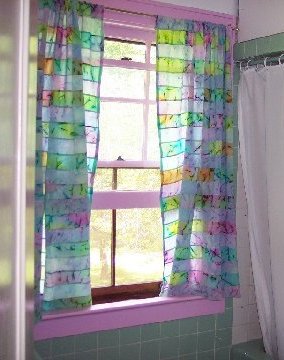
Here’s a pic.

Bathroom dyi paint job with crazy colors

I am rapturous. And thinking, wow, you know what would look great with this? A yellow ceiling . . . and for the floor, maybe purple, or robin’s egg blue . . .

lol

War on chemistry

This seems an awful shame: a variety of government agencies are using a variety of pretexts (including the War on Terror, anti-drug laws, and even regulations governing the use of fireworks) to crack down on companies that offer DIY home chemistry kits.

Steve Silberman has the story covered in Wired.

I can understand the impulse to ban these things. But I think we’ve crossed the line from reasonable caution to cut-off-our-noses paranoia.

I mean for crying out loud — we can’t even allow chemistry experiments in school any more?

The chemophobia that’s put a damper on home science has also invaded America’s classrooms, where hands-on labs are being replaced by liability-proof teacher demonstrations with the explicit message Don’t try this at home. A guide for teachers of grades 7 through 12 issued by the American Chemical Society in 2001 makes the prospect of an hour in the lab seem fraught with peril: “Every chemical, without exception, is hazardous. Did you know that oxygen is poisonous if inhaled at a concentration a bit greater than its natural concentration in the air?” More than half of the suggested experiments in a multimedia package for schools called “You Be the Chemist,” created in 2004 by the Chemical Educational Foundation, are to be performed by the teacher alone, leaving students to blow up balloons (with safety goggles in place) or answer questions like “How many pretzels can you eat in a minute?”

“A lot of schools don’t have chemistry labs anymore,”  explains CEF educational coordinator Laurel Brent. “We want to give kids lessons that tie in to their real-world experiences without having them deal with a lot of strange chemicals in bottles that have big long names.” 

“Big long names”???? You must be kidding me.

You know, my kid is bright, I’ll hand you that. But if she tests bright, I can guarantee you one reason is that the adults in her family NEVER talk down to her — we NEVER “kidify” our explanations of things, or dumb down our vocabulary.

When we’re looking at insects, for example, I don’t just do “oh, look at the fly. Oh, look at the beetle.” We catch it. We pull out the field guide. We do genus and species. We read about why a bug is a bug, why a Painted Lady is a brush-footed butterfly.

And she is a little sponge — she picks it up, quickly, and retains it. For two reasons: because I provide her the information, and because I’m obviously enthusiastic about it, which is infectious.

Meanwhile, at school — and ours is a good school, comparatively — the curriculum doesn’t bother providing this level of information. And I take issue with that.

I mean, life cycle of a butterfly is well and good, but if you repeat that the scientific name of a Painted Lady butterfly is Vanessa cardui, kids will learn it. Maybe not all the kids, but some of them will — and what’s more, I’m convinced it has a snowball effect. It’s like opening a door and showing a kid just how much information is out there. They naturally increase their capacity to learn, based on a sampling of just how much there is to learn.

But what are we doing, collectively, instead? We’re teaching kids to be passive. Worse yet, fearful.

Many students are ill at ease when faced with actual compounds and lab equipment for the first time at school. A study of “Chemistry anxiety”  in the Journal of Chemical Education concluded in 2000 that “the presence of this anxiety in our students could be a contributing factor in the overall poor performance of high school students in science.” (Commonly reported fears included “lighting the Bunsen burner,” and “getting chemicals on skin.”) Restrictions on hands-on chemical experience is “a problem that has been building for 10 or 15 years, driven by liability and safety concerns,” says John Moore, editor in chief of the JCE.

“The liability issues are a cop-out,” says Bassam Shakhashiri, the author of a four-volume guide to classroom chemistry who has taught for 36 years at the University of Wisconsin-Madison. “Kids are being robbed of the joy of discovering things for themselves.” Compared with students in previous generations, he says, undergraduates raised on hands-off science seem passive: “They want someone to do things for them. Even those who become chem majors and grad students are not as versatile in the lab, because their experiences in middle school and high school were so limited. This is a terrible shame. By working with real substances, you learn how to ask the right questions about the physical world, which is half the battle in science.” 

What this guy doesn’t perhaps realize is that it’s starting much, much younger than middle school. I had the pleasure of accompanying a field trip with my daughter’s 2nd grade class last week. They’re studying pond life. One of my responsibilities was to stand on the edge of a pond and help kids scoop mud from the bottom to find critters living in it.

I was astonished to find that some of the kids were bizarrely timid. Weirdly passive. They would sort of touch the strainer to the water and then, almost instantaneously, say “I can’t find anything.”

This floors me. You get a kid outside, out of the classroom, he’s got a chance to maybe catch a real life pollywog or something really awesome or creepy — and he doesn’t even have the most basic impulse to plunge a strainer into the water and DIG?

Argh. Argh.

So no wonder that by the time these kids get to middle school, they’ve progressed from passive to fearful — to being afraid not only of fire and chemicals on the skin but of “big long names.”

But such fear is not natural. It’s learned.

Shame on us, for condemning our children’s minds to darkness that way. Shame.

The day after

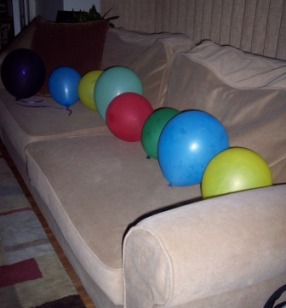
After a little girl’s birthday party :-)

balloons

(She was playing something this evening and set these up to be “the audience.”)

In which Kirsten fires another salvo in the Iris wars

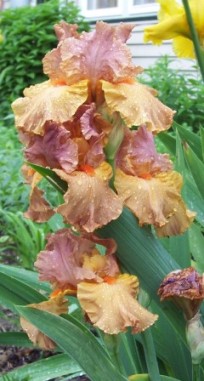
Isn’t this gorgeous?

Earthborn iris

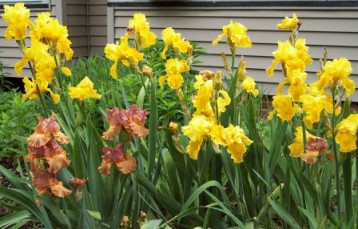
This one is called “Earthborn.” I planted a few of them to set off the yellow of “Harvest of Memories” and “Second Act.” It’s working pretty well although to really get the effect I want I’ll have to move things around a bit.

Iris grouping: Harvest of Memoris Iris, Earthborn Iris, Second Act iris

It’s funny how with perennials it can take several years to get things the way you want them — because you put something in, and then see how it looks throughout an entire growing season, then move it and see how that looks . . . it’s like painting in super slo-mo . . .

(Close-up of one of the yellow irises here.)