The downside of mild winter weather

freezing rain

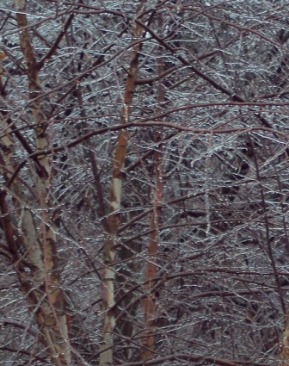
If, like me, you lived through 1991 ice storm in these parts — it crippled the Rochester, New York area for weeks — you can appreciate the trepidation I feel in waking up and seeing this.

That’s a river birch in my front yard. I took the picture three hours ago. Rain is still falling, and the ice is building up. Birches are particularly susceptible to permanent damage from this stuff. The only downside to using them as an ornamental.

They are dragged to the withered bracken by the load,
And they seem not to break; though once they are bowed
So low for long, they never right themselves;
You may see their trunks arching in the woods
Years afterwards, trailing their leaves on the ground
Like girls on hands and knees that throw their hair
Before them over their heads to dry in the sun.

Birches, Robert Frost.

The morning’s paper says we could get as much as 3/4 inches of ice before it’s over.

Let’s hope it warms up or switches to snow.

This is not a “fortune”

Has anyone else noticed that Chinese fortune cookies have become a huge disappointment over the past few years?

They never have actual fortunes in them any more.

I got this one last night:

Education is not filling a bucket but lighting a fire.

That’s not a fortune. That’s an aphorism.

What’s going on? Have the Chinese fortune cookie companies been advised by their attorneys to get out of the fortune-telling business? “We have to switch to aphorisms and ‘learn Chinese.’ Otherwise, someone will get squashed by a falling piano and we’ll be sued because his cookie said he was going to win the lottery instead of ‘avoid walking past open fourth story windows.'”

Or maybe they have been pressured by the astrology columnist lobby? “Get off our turf, Chinese fortune cookie company!”

Another possibility: fortunes are too difficult to write. Burn-out sets in. Everyone’s just a hack these days, durnit.

Or maybe it’s easier to avoid printing gaffes like the ones published here if you stick to sayings instead of fortunes . . .

Kodak sells health imaging division

Here’s the announcement as carried on Bloomberg [Update, link no longer good]:

Eastman Kodak Co., the world’s largest photography company, agreed to sell its health-care imaging unit to Onex Corp. for as much as $2.55 billion to help focus on its transition to digital products.

There’s also this:

The health group’s approximately 8,100 employees will stay with the unit after the completion of the sale, expected in the first half of this year, Kodak said. The transaction includes manufacturing operations and an office building in Rochester.

I know that office building well . . .

The people I’ve worked with at Kodak are, virtually without exception, such great individuals. Salt of the earth, dedicated, intelligent, decent people. I wish them the absolute best as they ride out this new wave of change.

It’s for the children

bench

There’s been much lamenting at the bus stop over the last month. Not from the parents. We parents are in general agreement that a mild winter is a good thing. But the kids have been outraged, outraged!

Here it is, Christmas already come and gone, and where’s the snow?

Denver, I guess. In Rochester, the official snowfall tally for December was 4.3 inches. Our average for that month is 21.9 inches. December 2006 was also our warmest on record. Links to the National Weather Service reports here.

Yeah, much lamenting. Until today. Almost an inch already this morning, with more on the way. Actually had to break out the snowpants and boots . . .

What I did last weekend

I’m planning a trip in February, and since I’m having a house sitter stay at my place to watch my critters while I’m gone, I decided it was time to fix up the guest bedroom.

Here’s what it looked like on Friday. I’d already pulled down the most recent layer of wallpaper — you can see one piece yet, above the window on the right. The stripes.

room before

Here”s the room now.

room after

The photo doesn’t do the ceiling justice. The color I chose for it is Benjamin Moore Seahorse 2028-70, a very pale green with a hint of yellow. For some reason the photo makes it look muddy; in person it’s very fresh & light. (The swatch on the website doesn’t look anything like the color either, at least on my monitor.)

The walls are Ocean Air 2123-50, the window trim and baseboards are done with Ice Mist 2123-70, and the molding at the ceiling is Sea Star 2123-30. They’re all in the same family — swatches here.

I picked the ceiling color because I wanted something warm to offset the cooler colors I chose for the walls and trim. Now that it’s up, I love the effect — I’m crazy about it, as a matter of fact. Particularly against that dark trim — I’m crazy about it.

Next: the floors, which I’m outsourcing ;-)

Then accessories. As I was drifting off to sleep last night I suddenly pictured drapes in a broad, vertical black and white stripe. Hmmmm . . . may be going to much toward Deco tho, we’ll see . . .

For beds, I have a twin set of antique Art Nouveau frames with carved swan heads. I’m a little nervous on them — need to pull them into the color scheme somehow — they’re finished in a cream — and unfortunately when I reupholstered the headboards years ago I picked a dark pink fabric — didn’t like it much at the time, really don’t like it now. It has to go.

Once I have that, the bedding, the drapes, and a rug sorted out, though, I’ll post another pic.

Seeing is believing

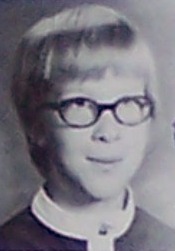
me sixth grade

At some point in fifth grade, I noticed the blackboard in Mrs. Marshman’s math class was blurry. I mentioned it to my parents, and within a few weeks had been fitted with my first pair of glasses.

I didn’t submit to the experience wholeheartedly, by any means. Most troubling was the sense that I was now damaged in some way. Poor eyesight is a mild disability for sure, generally more a nuisance than a crippler. Still, the finality of it weighed on me. It also complicated things. My eyeglass lenses were constantly in need of cleaning, the frames would get knocked about and no longer fit, and then, of course, came puberty, and to my other insecurities came the added burden of a reputation for braini-slash-nerdiness — of which my glasses were an obvious sign.

college photoThe body is always in a state of flux, of course, and once pointed in the direction of poor vision dutifully explores that trajectory; the silver lining was that as my eyesight worsened I swapped the hornrims for gold wire rims, and later contact lenses. Not quite so homely.

But I still hated them.

Then I learned about William Bates, an early 20th Century physician who had made the astonishing claim that poor eyesight is learned — and can be unlearned.

I read his book, Better Eyesight Without Glasses, tossed my contacts aside, and began muddling about the world without my visual crutch.

I was encouraged at first. With my eyes freed to function more naturally, my vision improved quite a bit right away; my right eye (the “weaker” of the two) went from 20/180 to 20/80 or so.

But 20/20 vision eluded me. I could induce it for short periods — I’ve passed vision tests, twice, for my driver’s license — but much of the time my world was still blurry. I didn’t put my glasses back on. But sometimes I wondered if the received wisdom wasn’t correct, after all. It seemed that perhaps poor eyesight is inescapable, a curse bestowed by our genes or the modern necessity of being tethered to close-up work, reading, computers.

Now I know differently.

The clues I needed were in another book, Relearning to See, by Thomas Quackenbush. I won’t bore you with the minutiae of my discovery, but the upshot is that I needed to relax and stop trying to see. By trying to see, I was distorting either the shape or the alignment of my eyeballs. When I relax, breath, and stop trying to see, the world around clears.

This isn’t a purely physical change. On the contrary, Candace Pert is right on when she says the body is the subconscious mind. Granted, straining to see has a measurable effect on the physical body (this image

myopia

is one Quackenbush reprinted from Bates’ Perfect Sight Without Glasses; the woman had perfect vision at the time the leftmost photo was taken. In the middle photo she has myopia — see how her eyes look different? And on the right, she’s furrowing her brow as she tries to see) — but it is first and foremost a condition of being. Put another way: my vision began to blur when I was a child not because my eyes were failing but because as I transitioned from early childhood into social awareness — when I began valuing how others viewed me — a kind of habitual anxiety that defined my relationship to myself hardened into fact. Little wonder the world around me went dim.

When I relax, breath, and stop trying to see, I feel something that affects more than my eyes. It’s like sinking back into a comfortable chair, a state of being in which I am letting go instead of struggling. The clarity of my vision is ancillary: a function of a different vantage point rather than a different way to hold the muscles of my eyes.

Quackenbush touches on this as well in his book, writing:

The individual with blurred vision is interfering with the normal, relaxed way of using the mind and body.

Plenty has been said about the way we modern folk are so stressed; how we react to non-physical stimuli with the same fight/flight response our forebears depended upon to escape saber toothed tigers. But how many of us realize that this response literally distorts our experience? It’s a perversion of our ability to think abstractly: we wrap ourselves in a kind of continual low-grade nightmare, little realizing that our anxiety defines what we can touch and know.

“Cultivate a habit of relaxation.” It’s the first New Year’s resolution on my list, because I’ve begun to understand that everything else flows from it . . .

Papa’s got a brand new cat fight

Via Booksquare, an article on the Hemingway cats.

These are the mitten-pawed descendents of the writer’s own cat, who are allowed to wander freely. Which means they sometimes leave the grounds of the Hemingway house, now a museum, in Key West. Which has upset Debbie Schultz, a neighbor and “former official” of the “local animal shelter.” She’s particularly bothered by a tom cat named Ivan:

“I saw Ivan many times loose,” she says. “Ivan is a very unneutered, very macho male cat, and in each case, he had one of the street cats pinned down,” she says. “We have an ordinance that says a nuisance cat can be removed.”

Well, at least he’s not very very unneutered!