Archive for the ‘Rochester, New York’ Category

Read this, please.

Friday, May 15th, 2009

How often do you read something that is so moving you want to cry, you want to shove it into the hands of everyone you know, hell, into the hands of strangers in the street?

Please read this. Essay by Mark Steyn, “Live Free or Die.”

Steyn’s got it all. First class intellect, international breadth of cultural & political perspective, wit, sharp eye.

Excepts. These are all quotes. “Reprinted by permission from Imprimis, a publication of Hillsdale College.”:

  • Indolence, as Machiavelli understood, is the greatest enemy of a republic.
  • So-called fiscal conservatives often miss the point. The problem isn’t the cost. These programs would still be wrong even if Bill Gates wrote a check to cover them each month. They’re wrong because they deform the relationship between the citizen and the state.
  • There are stages to the enervation of free peoples. America, which held out against the trend, is now at Stage One: The benign paternalist state promises to make all those worries about mortgages, debt, and health care disappear.
  • Once you have government health care, it can be used to justify almost any restraint on freedom: After all, if the state has to cure you, it surely has an interest in preventing you needing treatment in the first place. That’s the argument behind, for example, mandatory motorcycle helmets, or the creepy teams of government nutritionists currently going door to door in Britain and conducting a “health audit” of the contents of your refrigerator.
  • When the state “gives” you plenty—when it takes care of your health, takes cares of your kids, takes care of your elderly parents, takes care of every primary responsibility of adulthood—it’s not surprising that the citizenry cease to function as adults: Life becomes a kind of extended adolescence . . .
  • Every Democrat running for election tells you they want to do this or that “for the children.” If America really wanted to do something “for the children,” it could try not to make the same mistake as most of the rest of the Western world and avoid bequeathing the next generation a leviathan of bloated bureaucracy and unsustainable entitlements that turns the entire nation into a giant Ponzi scheme. That’s the real “war on children” (to use another Democrat catchphrase)—and every time you bulk up the budget you make it less and less likely they’ll win it.
  • The bailout and the stimulus and the budget and the trillion-dollar deficits are not merely massive transfers from the most dynamic and productive sector to the least dynamic and productive. When governments annex a huge chunk of the economy, they also annex a huge chunk of individual liberty. You fundamentally change the relationship between the citizen and the state into something closer to that of junkie and pusher—and you make it very difficult ever to change back.

Everything he writes, I feel in my bones. Truly, I am so distressed by the direction our government is taking that I can only look at it peripherally — to look straight on would distress me to madness.

I love this country so much. I look at my life, at what I’ve accomplished — when else in history, where else on the planet, could a woman live the life I’m living? No other time in history. And as for “where,” the answer is this country, my country, America. A few other Western countries come close, possibly. But none of them with the space, the possibilities, & wealth of this country.

And we’re frittering it away, because we want our government to baby us. Because when we are faced with life’s sharp edges, we choose to be timid and fretful and whine for help instead of saying “we’ll get through it. We’ll figure out a way. We’re strong.” And meaning it. And taking pride in it. Pride!

Is this what the Dem party supporters wanted? A government that plays to our weakness? That grows, and grows, and taxes, and taxes, promises to solve our little problems, assumes more & more control in the name of solving them — tell me, you people who voted for Obama, are you getting what you wanted? Is this what you wanted? Is it?

Are you happy?

Do you really think we have a Caring Man in the White House now and that’s going to make everything better, give him time, it’s not his fault he inherited such a mess? I assume that’s what left-leaning intellectuals would claim, am I right? Do you really, honestly believe that? That the changes he’s making to our country are all benign, their consequences will be neutral at worst, that they are credible, that it’s all about patching and fixing? That the politicians running our government — those same politicians you would agree as individuals are idiots — are somehow, collectively, qualified to do the patching and fixing?

Before the election an interview Obama gave on Chicago public radio in 2001 surfaced. I never linked to it, but I’ll embed it below; here also is a transcription I made of the relevant bits. Our future president speaking, folks. Read it closely, please, pay attention, please.

You know, if you look at the victories and failures of the civil rights movement and its litigation strategy in the court, I think where it succeeded was to invest formal rights in previously dispossessed peoples, so that now I would have the right to vote. I would now be able to sit at the lunch counter and order and as long as I could pay for it I’d be o.k.

But the Supreme Court never ventured into the issues of redistribution of wealth, and, sort of, of more basic issues such as political and economic justice in the society.

And to that extent, as radical as I think people try to characterize the Warren Court, it wasn’t that radical. It didn’t break free from the essential constraints that were placed by the founding fathers in the Constitution — at least as it’s been interpreted — and Warren Court interpreted it in the same way — that generally the Constitution is a charter of negative liberties. Says what the states can’t do to you. Says what the Federal government can’t do to you. But it doesn’t say what the Federal government or State government must do on your behalf. And that hasn’t shifted and one of the, I think, tragedies of the civil rights movement was, um, because the civil rights movement became so court-focused, I think there was a tendency to lose track of the political and community organizing and activities on the ground that are able to put together the actual coalition of power through which you bring about redistributive change. And, um, in some ways we still suffer from that.

We elected this man. We elected him to uphold our Constitution — without ever ONCE looking at what he plans for our Constitution.

The entire pre-election debate was about namby pamby crap. Petty sh!t. Not once did we discuss what is really important.

But as Steyn’s essay asserts, there are consequences when people expect governments to do things “on their behalf,” as opposed to operating in terms of those negative liberties, in terms of what its limits are relative to its citizens.

The left looked at the future under Republican rule and saw a militaristic America alienating other nations and promulgating racism.

Bad stuff. I agree we don’t want to go there.

But are we really on a better path?

No, we are not. We’re on a path to ruin. Maybe on a different route than the GOP would take us, but the destination is the same.

Steyn, again:

Americans face a choice: They can rediscover the animating principles of the American idea — of limited government, a self-reliant citizenry, and the opportunities to exploit your talents to the fullest — or they can join most of the rest of the Western world in terminal decline. To rekindle the spark of liberty once it dies is very difficult. The inertia, the ennui, the fatalism is more pathetic than the demographic decline and fiscal profligacy of the social democratic state, because it’s subtler and less tangible. But once in a while it swims into very sharp focus. Here is the writer Oscar van den Boogaard from an interview with the Belgian paper De Standaard. Mr. van den Boogaard, a Dutch gay “humanist” (which is pretty much the trifecta of Eurocool), was reflecting on the accelerating Islamification of the Continent and concluding that the jig was up for the Europe he loved. “I am not a warrior, but who is?” he shrugged. “I have never learned to fight for my freedom. I was only good at enjoying it.”

But not to worry. In fact: sleep in. Spend your life in bed, it’s so comfortable! reading, watching T.V., surfing the net.

Genteel decline can be very agreeable—initially: You still have terrific restaurants, beautiful buildings, a great opera house. And once the pressure’s off it’s nice to linger at the sidewalk table, have a second café au lait and a pain au chocolat, and watch the world go by.

You don’t even have to roust yourself to attend those anti-war rallies any more! Now that Chimpy’s out of office! Niiiice!

So go ahead, have a glass of wine, a glass of beer, go back to bed, such a nice man in charge now, and those fools called him a Socialist! Go back to bed.


Pileated Woodpecker in my backyard

Friday, April 24th, 2009

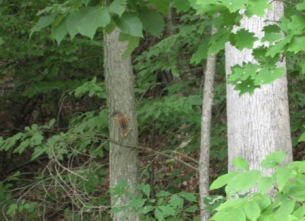
pileated-woodpecker4Okay, excuse me while I flip out — but I can count on one hand the number of times I’ve seen one of these guys — then this afternoon, didn’t I walk out my back door and see a Pileated Woodpecker working the bark of a tree, right here in the ‘burbs!


If you’ve never seen one — you know right away it’s a Pileated because they’re BIG. Crow size.  Of course, if you can get a close enough look you will also see the “woody woodpecker” red crest like shows up in this pic.

pileated-woodpecker3

I wish my pics had come out clearer. I actually got quite close, but he was on the shady side of the tree so the clarity isn’t the best . . .

For most of the time I watched him, he was working one particular crack in the tree. This pic shows how they use their tails to brace themselves.  He’s twisted his head around to try to work something out from under the bark. Late lunch :-)

Here’s one more that I didn’t crop as much so you can see more what he looked like when I first noticed him.

pileated-woodpecker2Pileated Woodpeckers need a habitat with mature forest and lots of deadwood. Must be there’s enough of the stuff he likes in Brighton . . . I sure hope so, would love to see this fellow again sometime!


Oink oink, Rochester at the trough

Sunday, March 1st, 2009

Senator Keating Blvd Rochester New York

The map shows Senator Keating Blvd, a bit of road south of the Tops Plaza on Clinton Ave. in Brighton.

It tops the list that Chuck Simmons has posted of local pork projects. Price tag for this project: $3.6 million — although I’m not really sure what the money’s going for — this description, courtesy of the NYS DOT & published by Stimulus Watch, is laughably impossible to interpret:

From the NYS DOT Website: “According to the Town of Brighton’s Master Plan, a road is needed to connect South Clinton Avenue with Winton Road. This road, called Senator Keating Boulevard, would be constructed by others as the development in the area occurs. For all alternatives considered, it was assumed that Senator Keating Boulevard would be constructed by others and be complete by the year 2028. Regardless of which alternative is progressed, development in this area will continue and Senator Keating Boulevard will be constructed as a requirement of the Town of Brighton.”

I guess that means the road that we all “assumed would be constructed by others” (those Others! always backing out of their promises!) is now going to be funded by the Stimulus Bill — and as a result, we’re going to run Senator Keating Blvd through the back side of Buckland Park — creating a parallel to Westfall through currently undeveloped land? Now, instead of in 2028?

Oink oink oink.

Do go peruse Chuck’s list, there’s lots more of the same, if you have the stomach for it.

Where the money goes in NYS

Sunday, January 25th, 2009

Nobody really knows, as is once again made abundantly clear, this time in the aftermath of Joe Bruno’s ethics indictment. Here’s James Odato, writing in the Albany Times-Union:

Dollar amounts on state financial disclosure forms, which are not published on the Internet, exist as only broad ranges of value — and even those vague range values are withheld from the public. Descriptions of income or gift sources are allowed to be similarly opaque.

Public officials in New York are not required to disclose conflicts of interest. Such conflicts, when they are discovered, are actionable only if ethics officials, who operate in secrecy, deem them to be “significant.” And state prosecutors cannot bring criminal charges under the state’s ethics laws without a referral from an ethics panel, which consists of members appointed by the very politicians they regulate.

Even if prosecutors clear those hurdles and bring charges, a violation of the ethics law is only a misdemeanor, not a felony.

We pay the highest taxes in the country. Our revenue per capita ratio is one of the highest in the country. Yet Albany is out of money, and is preparing to tax us even more.

How can this happen? Because the Empire State has been hijacked by thugs.

“There is no watchdog,” said Blair Horner, legislative director for the New York Pubic Research Interest Group. “You’ve had an astonishingly long list of lawmakers getting into trouble. We haven’t reached the tipping point yet.”

Horner said it isn’t surprising Bruno didn’t take ethics oversight seriously: The ethics panel, chosen by him and Assembly Speaker Sheldon Silver, has never charged any lawmakers with wrongdoing.

Of course it hasn’t.

How much shall we spend to make Monroe County residents stupid?

Tuesday, January 6th, 2009

Sheep

$88,000 a year sound like a good figure?

Because–as I posted last summer–that’s what we spend annually to fluoridate our water in this county.

I’ve been fuming about that figure again lately, and not only because we’re facing the prospect of unprecedented tax hikes, thanks to the poor fiscal management of our pols.

There’s also, this, now: A new round-up, courtesy of the Fluoride Action Network, of 23 studies to that link fluoride consumption to lower IQ.

Much of this research was originally published in China, but the FAN is translating it.

Meanwhile, the National Research Council, which has reviewed a handful of these studies, says “the consistency of the collective results warrant additional research on the effects of fluoride on intelligence.”

Yeah, well how about discontinuing mass fluoridation of our water until we know for sure, folks?

It’s almost enough to make you believe the conspiracy theorists who think the government is deliberately trying to make people stupid.

At the least, it’s a clear window into how these agencies view their responsibilities toward the American people. They’re not going to err on the side of protecting us from brain damage. What do they care if our kids’ IQ loses 5 or 10 points? They’re collecting their salaries, and seeing their names published in prestigious medical journals, and being invited to speak at all the right conferences.

Nice people. So glad they’re in charge.

be ye therefore wise as serpents . . .

Friday, August 1st, 2008

garter snakes

Get ready for some Albany weepin’ & wailin’

Tuesday, July 29th, 2008

You got it, New Yorkers: a bloated, paraciticistic bureaucracy that taxes us rapaciously one day, then gives a bit back (aka pork projects, STAR rebates) the next with a nice wet “see all we do for you?” kissy kiss.

Apparently it works for most of us most of the time. But what about now, when the economy is stumbling?

We’ll soon find out: as the WS Journal reported a few days ago, New York is one of many states facing a huge tax shortfall.

A spokesperson for Paterson is out there softening us up with the words “fiscal crisis.”

The Albany Times-Union piece lists some possible solutions. Guess what they cite at #1? Raise taxes, of course.

Once you’ve fed it and fed it and fed it, you can’t cut it off — it won’t let you.

Good thing the government’s in charge of keeping us happy and healthy and entertained! Such a deal, such a deal!

Let’s squish the Square

Monday, July 21st, 2008

The economy is teetering. Our food & gas prices are climbing. And, lest we forget, we citizens of New York are the highest taxed in the country.

So how do we want our politicians to spend our tax money?

If you’re a construction worker, you’ll answer: Build Renaissance Square! Because yeah, if that happens, you’ll have a job for, ya know, a few months.

I can understand that. But what comes next?

Most likely, a big long morning after. For example, take this article by Mark Yost in the Wall Street Journal. He’s writing about sports stadiums, but what he says is enough to remind you of your worst public project hangover.

Sports economists have long argued that publicly financed stadiums are a waste of taxpayer money. And they have the data to prove it.

Yes, stadiums do create high-paying construction jobs for a year or two. But the vast majority of long-term employment is low-wage concession jobs. A Congressional Research Service study of the Baltimore Ravens stadium found that each job created cost the state $127,000. By comparison, Maryland’s Sunny Day Fund created jobs for about $6,000 each . . .

Then there’s the fact that only a sliver of the tax base really benefits from a sports stadium. And with ticket prices rising rapidly, that group is getting much smaller.

Consider the New York Yankees, who have the highest payroll in baseball and take in more than $300 million a year just from their television network. They’ll move into a new $1 billion stadium next year, about half of which was covered by the taxpayers. Seats behind home plate that cost $250 this year will be ten times that next year. The net result is that very few of the people who paid for the stadium will be able to afford a seat there.

But perhaps the best argument against publicly financed stadiums is straight out of Econ 101: Opportunity cost.

“What else could the city have invested its money in and what kind of a return would it have produced?” said King Banaian, chairman of the St. Cloud State (Minn.) Economics Dept. Despite reams of evidence to the contrary, the District proceeded with what Councilman Kwame Brown calls “the most controversial project in the history of the city.”

It was controversial, he said, because the city had more pressing needs. The city’s schools are in shambles; crime is out of control; and unemployment in distressed neighborhoods, like Southeast, is double the national average, if not higher.

Fortunately, people are raising their voices. In City Newspaper, Mary Anna Towler asks a whole slew of questions about Ren Square that need to be asked.

Was the big theater the best theater for Ren Square? If MCC or SUNY owns the theater, will taxpayers’ money be diverted from education to subsidize the theater?

If there’s not enough money for the theater, should we go ahead with the MCC campus and the bus station?

And: does downtown Rochester need Ren Square? A few years ago, it seemed to be about the only development hope we had. That’s no longer true. Is it a good idea to build Ren Square, taking prime development land out of the private market - and taking that land off the tax roles?

There’s also an excellent comment after the City piece:

It would be good if the transit portion of the project were as closely analysed as the PAC. Shouldn’t we also notice that over $100 million TRANSIT dollars are essentially being squandered in a way that will make the bus system slower, less efficient and much more costly to operate? Ther is no advantage to the city to leave the auditorium theater and sibleys building empty, as the current plan would do.To pursue such a plan in an environment of record gas prices, (not to mention global warming) falls on the spectrum between “sub optimal use of public funds” and “complete insanity”. The bus station is both the achilles heel and fatal flaw since it literally cannot be used by buses. This might explain why no traffic study has been done.

Hopefully the Ren Square cloud will clear in time to save the federal transit funds to use for badly needed transportation projects that actually move people TOWARDS their destination at lower energy and lower cost.

We have already spent $15.8 million on the Renaissance Square project.

Are we going to wake up and say “no more” before it’s too late?

You know we’re in trouble when our best hope is that Chuck “Godzilla” Schumer will find a way to jinx Ren Square like he did Indy Mac.

I won a golf tournament :-)

Sunday, July 20th, 2008

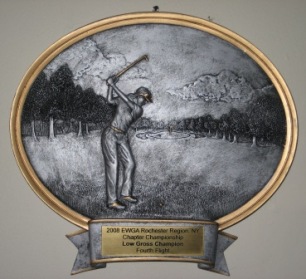
my plaque

Rochester region EWGA chapter tournament, played at Ravenwood yesterday. I shot a 101 and took low gross for my flight.

I’m a happy camper :-)

Cross-posted at Golfolicious.

Eye-spotted Ladybug

Sunday, June 29th, 2008

I haven’t found one of these since I was a kid . . .

Isn’t it gorgeous?

Eye-spotted Ladybug

Most the ladybugs we see anymore are non-native species that were imported by the U.S. Dept of Agriculture in the 70s to control agricultural pests.

Sounded like a good idea at the time, but they’ve driven out many of our native species.

The law of unintended consequences.

And look what else I found: Cornell University is asking kids to find and photograph native ladybugs and submit the photos with a little supporting data (date and time seen, location, habitat).

To be able to help the nine spotted ladybug and other ladybug species scientists need to have detailed information on which species are still out there and how many individuals are around. Entomologists at Cornell can identify the different species but there are too few of us to sample in enough places to find the really rare ones. We need you to be our legs, hands and eyes. If you could look for ladybugs and send us pictures of them on Email we can start to gather the information we need. We are very interested in the rare species but any pictures will help us. This is the ultimate summer science project for kids and adults! You can learn, have fun and help save these important species.

The website tells about how a couple of kids found a nine-spotted ladybug in Virginia in 2006 — the first sighting of this species in the Eastern U.S. in 14 years. Isn’t that cool?

And what a great environmental science-based summer activity!