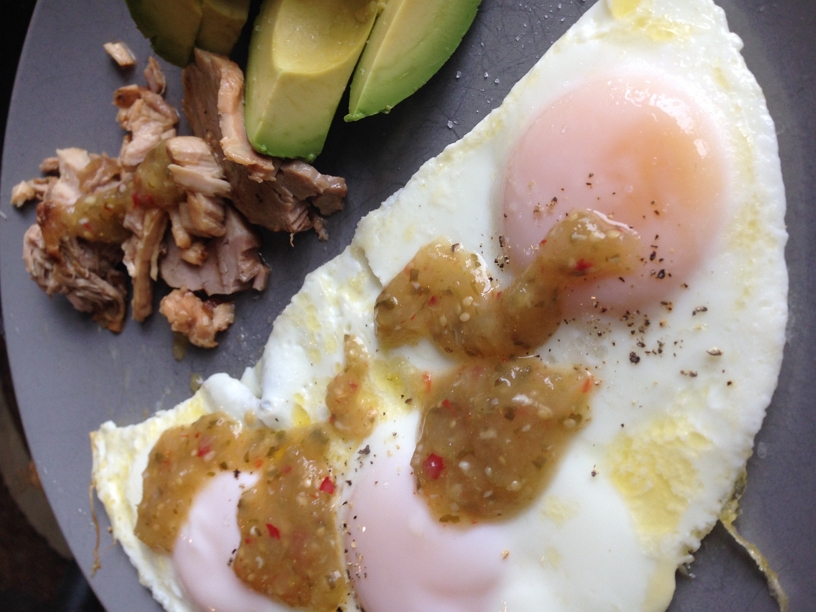
So I’m resigned to the fact that I will never be able to take really pretty food pictures. But this is what a typical breakfast looks like–just pretend it is has starbursts and stuff.
No, I am not jumping on a fad.
I already jumped–a year ago!
And before I jumped, I already had a nice foundation in place: I’d been doing intermittent fasting for 3 or 4 years before that …
Okay. Being a writer, I could spin out 6000 words on this topic without drawing a breath, so I’ll try to keep it short.
Here’s what happened.
Back in the late 90s/early 2000s I used low carb to slim back down after having a baby. But I thought of it, back then, as a way to lose weight, not as a way to improve other health markers. So after a few months I went back to eating the way I had before.
“The way I’d been eating before” wasn’t the so-called SAD (Standard American Diet) diet fwiw. I haven’t eaten that way since high school. I got on a “whole foods” kick in my early 20s and have been refining it ever since. But it did include quite a few carbs: grains with every meal, desserts (organic ice cream, that sort of thing). Lots of fruit.
But four or five years ago something happened that raised a red flag for me.
It was a busy Saturday. I was out running errands. I hadn’t eaten in several hours–one of those days when eating takes a back seat to other priorities.
I stopped at a Starbucks and ordered a mocha coffee–i.e. sugar laden high carb treat.
And a couple hours later, I crashed. Shaky, nauseous, weak, light-headed–I felt horribly sick.
It wasn’t an unfamiliar feeling. I’d been a “grazer” for a long time, with good reason: I couldn’t go more than 3 or 4 hours without eating, or I’d start to feel those symptoms.
But the intensity of the experience shook me up.
I wasn’t obese. I was working out (weight training) twice a week. But I was carrying probably 10 or 15 extra pounds. That, combined with my sugar crash, was a wake-up call. If I was having this kind of a reaction to sugar now, what was I facing in 5 years, or 10, or 15? Were the extra pounds I had put on as I aged affecting me in ways that were slowly undermining my health? Was my diet really the best diet for me?
I’m a regular reader of the “primal living” health blog at Mark’s Daily Apple, so by then I’d come across a term Mark Sisson coined: “fat-burning beast.” The basic idea is one that keto fans will find familiar. You can train your body to burn fat for energy instead of glucose, and when you do, you break your dependency on carbs. You won’t experience sugar crashes any more. You won’t have to eat all the time any more.
This was before Keto diets were all the rage, but I knew that day that I needed to become a fat-burning beast.
I started intermittent fasting.
There are a lot of different ways to do intermittent fasting. The approach I picked was to fast for 24 hours, breakfast to breakfast, twice a week.
It was really hard at first. More than once I’d hit a wall about 2 in the after noon. My body temp would drop, my energy levels would plummet. I’d have to crawl into bed under the covers to warm up and sleep just to get through it. (Working from home helps!)
But after a few months, my body adapted and holy smokes, what a revelation.
I was no longer dependent on food!
Guys, you know I’m a golfer. I used to have to pack food with me when I golfed so that I could get through a 4-5 hour round without wanting to pass out. Now, all of a sudden, it didn’t matter. I could go out in the morning without eating breakfast and play a round without the slightest discomfort.
And needless to say, no more sugar crashes. And I lost a few pounds which felt good.
Then came the Keto thing. Sisson started blogging about it. He announced he had a book coming out.
I didn’t hesitate. I pre-ordered the book and as soon as it arrived started planning a 6-week Keto clean-out.
That was a year ago. This week, my sweetheart and I are doing the 6-week thing for the second time :)
To me, Keto delivers the same effects as fasting. Energy levels that are both high and steady; clear mind; body gets that lovely, compact feeling (versus the bloated feeling I get when I’ve been eating too many carbs).
We also found that the effects of a six-week Keto clean-out last–really for the whole rest of the year. I still fast from time to time but it’s more of a touch-point now. Being “keto-adapted,” I don’t ever need to eat (freedom!!!) Going 24 or even 48 hours without eating doesn’t faze me. I energizer bunny right through :)
It also kind of pulled our diet in a keto direction even though we didn’t bother staying in “strict keto” once the six weeks was up. If I was at a restaurant and they put out fresh Italian bread with olive oil, I’d eat a slice and enjoy it. OTOH if I was hungry for a burger I’d order it without a bun. I.e. I didn’t seek out carbs, but I didn’t shun them.
Keto is definitely a fad today, with all the hoopla you get with diet fads. People denouncing it as dangerous, blah blah blah. Or defining keto erroneously (“you eat pounds of meat every day! and no veggies!” yeah right…) and then clapping themselves on the back for knocking their straw man over.
Silly. Not even going to bother engaging on that stuff. Go read Sisson if you want thoughtful, in-depth, science-based considerations of dietary arguments.
What I also see a lot of is people who–let me put this nicely–need a bit of help understanding how to do it.
So at the risk of turning this post into an all-Sisson read: I really recommend Sisson’s book, The Keto Reset Diet: Reboot Your Metabolism in 21 Days and Burn Fat Forever
Actually, let me amend that: if you are thinking about doing keto for the first time, just go buy the book.
Because it’s about preparing yourself for keto. And you owe it to yourself to build a foundation if you’re new to keto–and especially if you are like I was: the sort of person who needs to eat every couple of hours to keep your energy levels steady.
Going keto “cold turkey” can make you feel like crap. Just like I felt that day years ago when I sugar crashed from my mocha coffee.
But if you prepare your body, things will be easier. And if you have a framework–a little bit of the science–you’ll understand what you’re doing and how to do it right.
Plus the book has a bunch of recipes and we found most of them to be absolutely delicious. So there’s that, too–you can plan your menus without having to hunt for ideas.
Happy ketoing!