Nature


You may have seen the headlines recently when Consumer Reports released new a study reporting BPA (Bisphenol A) levels in canned foods.

Here’s a more extensive write-up of the Consumer Reports report.

You may also have heard that organic companies didn’t do any better in the study.

I don’t eat a lot of canned foods, but there’s a couple of organic soups in Hain’s Imagine line that aren’t bad — my daughter’s fond of them, so I’d been keeping some on hand for those times when she needed a quick snack.

I’d just as soon her quick snacks aren’t dosed with endocrine disruptors, however. So I wrote Hain’s to ask if they use BPA-free cans.

Just got my answer.

Thank you for taking the time to contact us regarding our Imagine Soup. We strive to maintain the highest quality products and appreciate your patronage.

Most metal food and beverage packaging has a thin coating of an epoxy containing BPA on the interior surface. Bisphenol A (BPA) is a compound used in most metal food and beverage packaging. The interior surface of the can has a thin coating of an epoxy containing BPA, which protects public health by preventing corrosion of the can and contamination of food and beverage by not coming in contact with the metal. This is one of the very few FDA approved coatings that will provide the safety and shelf life that consumers expect from our products. Tests have indicated that trace amounts of BPA may be present in these can coatings. The minute amounts detected are well below levels deemed to be of concern for public health according to the FDA.

The United States Center for Disease Control and The American Council on Science and Health, along with other Regulatory agencies worldwide, have extensively researched Bisphenol A and concluded there is no risk to human health. All coatings that come in contact with our products undergo stringent testing and comply with US Food and Drug Administration guidelines.

We are currently looking for other alternatives.

As the Atomic News piece linked above notes, it’s not easy for companies to find suppliers of epoxy-lined cans. But Eden has managed to do so:

The Ball Corp. eventually agreed to produce custom runs of cans with oleo-based C-enamel linings for Eden. It’s also doing research to develop BPA-free can coatings that could work for more acidic foods such as fruit, which Eden now markets in glass containers. “It’s costing me 14 percent more for these BPA-free cans, but I said I have to do this because not only do I eat canned foods, but so do my kids and grandkids,” [Eden Foods President and Chairman Michael] Potter says.

Eden’s canned foods, incidentally, still contain traces of BPA, but at far lower levels than Consumer Reports found in other canned foods.

Consumer Reports tested Eden cans, confirming they are BPA free.

So where does the contamination come from? Who knows. The results, CR says, suggest “that food can have multiple sources of exposure.”

Great.

To my environmentalist friends, this is one reason why I have trouble jumping on the global warming bandwagon. Endocrine disrupters are having an effect on the environment right now. Alarming numbers of male freshwater bass are now growing eggs, for instance — their sexual organs are being messed up. That’s scary stuff, because it means something is going on with our water, and ya know, I like to drink water.

I’d rather see us tackling these more immediate problems of environmental contamination than pouring trillions into preventing a problem that is, so far, a figment of a computer model’s imagination.

Scientists form hypotheses and then subject them to rigorous review and testing.

Propogandists attempt to shape public perception and opinions.

Given the contents of the files leaked from the Climate Research Unit at East Anglica University, it’s pretty clear the global warming community has been led by propogandists.

Their priority was not science.

It was controlling information. It was influencing the public’s perception of issues related to their pet cause.

If you’re looking for more reading on this, may I suggest:

  • Longtime global warming skeptic Jeff Id (“an aeronautical engineer by training but work as an optical engineer”) published this blog post yesterday. It explains why he’s had longstanding issues with the Global Warming researchers’ use of “proxies” and suspect correlations.
  • Not directly related to the CRU scandal topically, but this 2008 paper by Steve McIntyre describes the work he had done to date in auditing climate data. It provides useful background on why so-called skeptic’s questions have validity.

Until a few years ago, I never saw deer in my neighborhood, but we’ve got them now — and the family’s growing. I’ve seen these fawns many times while out walking my dog. Took this pic out of my office window a couple mornings ago.

neighborhood fawns

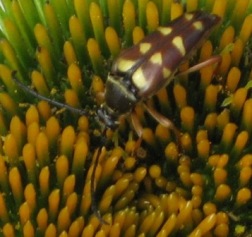
Only I’m not sure which one. Anybody know?

long horned beetle

Definitely Cerambycidae, based on the body shape, showiness, length of the antennae, etc., but this particular one’s not in my copy of Petersen’s field guide to NA insects, and I can’t find a pic of it on the ‘net, either . . .

long horned beetle2

I can remember as a kid that May 31st was considered the safe “frost free” date for planting gardens. That was in Chenango County though. Here near Lake Ontario, where the elevation is also considerably lower, it’s Zone 6, not Zone 5. So I guess you’d have to call this “unseasonably cold.” Right?

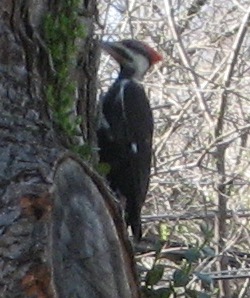
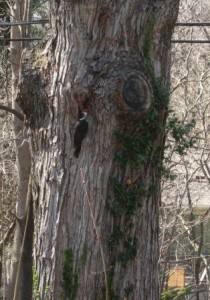
pileated-woodpecker4Okay, excuse me while I flip out — but I can count on one hand the number of times I’ve seen one of these guys — then this afternoon, didn’t I walk out my back door and see a Pileated Woodpecker working the bark of a tree, right here in the ‘burbs!
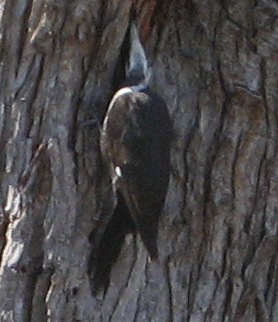
If you’ve never seen one — you know right away it’s a Pileated because they’re BIG. Crow size.  Of course, if you can get a close enough look you will also see the “woody woodpecker” red crest like shows up in this pic.

pileated-woodpecker3

I wish my pics had come out clearer. I actually got quite close, but he was on the shady side of the tree so the clarity isn’t the best . . .

For most of the time I watched him, he was working one particular crack in the tree. This pic shows how they use their tails to brace themselves.  He’s twisted his head around to try to work something out from under the bark. Late lunch :-)

Here’s one more that I didn’t crop as much so you can see more what he looked like when I first noticed him.

pileated-woodpecker2Pileated Woodpeckers need a habitat with mature forest and lots of deadwood. Must be there’s enough of the stuff he likes in Brighton . . . I sure hope so, would love to see this fellow again sometime!
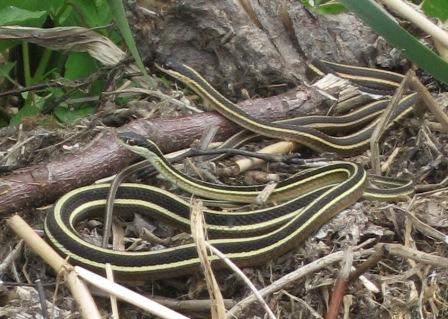

garter snakes

I’m working! But I couldn’t resist trying for this pic :-)

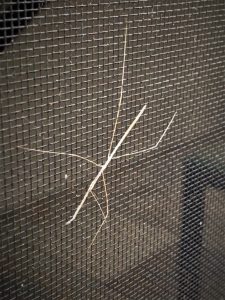
Spider

I usually compress files a bit more but he lost too much of his definition when I did — sorry if the image loads kinda slow . . .

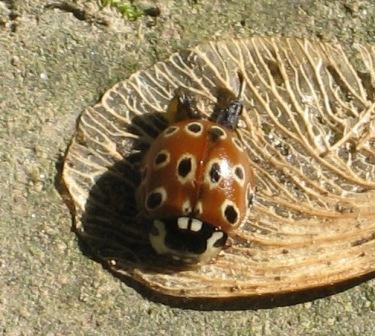
I haven’t found one of these since I was a kid . . .

Isn’t it gorgeous?

Eye-spotted Ladybug

Most the ladybugs we see anymore are non-native species that were imported by the U.S. Dept of Agriculture in the 70s to control agricultural pests.

Sounded like a good idea at the time, but they’ve driven out many of our native species.

The law of unintended consequences.

And look what else I found: Cornell University is asking kids to find and photograph native ladybugs and submit the photos with a little supporting data (date and time seen, location, habitat).

To be able to help the nine spotted ladybug and other ladybug species scientists need to have detailed information on which species are still out there and how many individuals are around. Entomologists at Cornell can identify the different species but there are too few of us to sample in enough places to find the really rare ones. We need you to be our legs, hands and eyes. If you could look for ladybugs and send us pictures of them on Email we can start to gather the information we need. We are very interested in the rare species but any pictures will help us. This is the ultimate summer science project for kids and adults! You can learn, have fun and help save these important species.

The website tells about how a couple of kids found a nine-spotted ladybug in Virginia in 2006 — the first sighting of this species in the Eastern U.S. in 14 years. Isn’t that cool?

And what a great environmental science-based summer activity!

Glenn Reynolds has been advocating the adoption of flex-fuel technology for our cars. The basic idea is that if our cars could run on ethanol and methanol as well as gasoline, we’d reduce our dependence on foreign oil.

The cost to convert our cars would be about $100 per.

Leave aside the ominous suggestion–on odd one coming from the good professor–that the technology be government-mandated, and it may well be a fine idea. But there’s another option that would be simpler to implement and would cost a whole lot less.

I first read about it in this article about hypermiler Wayne Gerdes.

Hypermilers try to improve their gas mileage by changing the way they drive.

Gerdes has taken the idea to an extreme–including doing things that are arguably unsafe.

But there’s still something here for the rest of us those of us–stuff like not accelerating so quickly at green lights, using cruise control for highway driving, and coasting to stops when possible.

The upside: according to this article on CNN.com, adopting some of the hypermilers’ techniques could reduce our national gas consumption by 35 percent.

It would help, of course, if we could get immediate feedback on how much gas we’re using, as we use it. And we can: according to Gerdes, it would cost only $10-20 to install fuel consumption gauges in our cars.

Personally, I don’t want our politicians mandating any auto upgrades–too much potential for mischief. But I’d gladly spend an extra $20 myself to be able to monitor my gas consumption in real time.

And hey, if that 35 percent figure is anything like correct, the gauges would about pay for themselves by the time we get home from the new car lot.

Technorati Tags: , , ,

Next Page »