Golf


New post over at my Golfolicious blog. My remedial driving range session this weekend. Plus a link to a youtube tip on how to fix a slice that you need to see. If you slice, of course. Which we all do from time to time, don’t we?

:-)

Click here to read about Lakeside Country Club, a very nice course overlooking Keuka Lake, which we played in June.

Keuka is one of the prettiest Finger Lakes, and is also where my mom spent part of her childhood :-)

Late last night, after a negotiating a harrowing technological labyrinth on and off for several days, I managed to upgrade to the latest Wordpress version on my golf blog, Golfolicious.

It shouldn’t have been hard. I’ve put up a half dozen WordPress sites at this point; for the installation, my preference is Fantastico, an application deployment tool bundled with many hosting services. You pretty much click a button and you’re done. Even better, when it’s time to upgrade, you can use the same tool.

My Golfolicious WordPress instance, however, wasn’t originally installed using Fantastico — so I hesitated trying to use the tool to upgrade.

I could have done a manual upgrade, but the instructions published in the Wordpress codex were long, complex, and included steps that I would have had to research further to fully understand.

Finally, I hit on another idea. I own the .net and .org versions of the domain name, as well as the .com. Maybe I could install a current version on the .net, transfer my theme, posts, and comments over, and then point the .com to the .net when I was done?

Call that plan B. Plan A, executed only when I’d done enough research on Plan B to satisfy myself that it was viable, was to try Fantastico.

I did. Didn’t work. Broke the site. Took me awhile to backtrack enough to make it somewhat usable again.

Plan B, OTOH, worked like a charm — particularly since the WordPress Wizards, my heroes, have built in handy import/export tools that make it extremely simple to transfer posts & comments between blogs/URLs/host servers.

Is there anything they haven’t thought of?

I heart WordPress!

And while I’m at it, I also heart Hostgator, my hosting service. Their chat tech support staff are awesome. They are patient, they are cheerful, they take the initiative to do a little extra research if needed to make sure an issue is resolved satisfactorily — my experience with them has really been top notch.

So thanks for all your help as I wrestled through that upgrade, Hostgator!

Now I need to catch up on golf blog posts. I put one up after I finished the upgrade last night — post about a late June trip to play a couple of courses at the Turning Stone resort. Scroll down to see my photo of a wild turkey :-)

Another (oh too short!) golf trip last weekend, this time to Florida.

We were startled our first day out when a gigundous bird flew over — low, buzzed us, just above our heads.

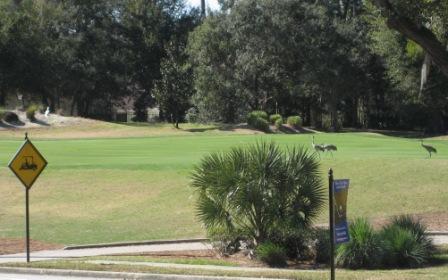
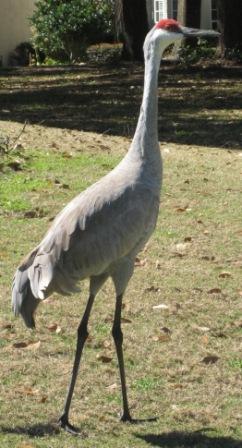
We got a better look on Saturday when we played Victoria Hills (in Deland, near Orlando). Turns out they are Sand Hill Cranes. Here’s three of them strolling the 12th green.

sandhill cranes

sandhill crane

They weren’t very afraid of people, so I was able to get some nice close shots too. It was funny to see them on the course like that, too. Got me to thinking . . . that head . . . I could probably putt with that guy . . . then again, maybe not . . .

The chief difficulty Alice found at first was in managing her flamingo: she succeeded in getting its body tucked away, comfortably enough, under her arm, with its legs hanging down, but generally, just as she had got its neck nicely straightened out, and was going to give the hedgehog a blow with its head, it would twist itself round and look up in her face, with such a puzzled expression that she could not help bursting out laughing: and when she had got its head down, and was going to begin again, it was very provoking to find that the hedgehog had unrolled itself, and was in the act of crawling away: besides all this, there was generally a ridge or furrow in the way wherever she wanted to send the hedgehog to, and, as the doubled-up soldiers were always getting up and walking off to other parts of the ground, Alice soon came to the conclusion that it was a very difficult game indeed.

:-)

More pics of the course on my golf blog.

I’ve gotten around, finally, to posting pics of the golf courses we played during our Arizona trip. They’re on my golf blog.

Dove Valley Ranch.

Longbow Golf Club.

Rancho Manana.

And of course, The Boulders South Course.

Lots of pics, so click through and enjoy :-)

Break in posting because I spent a few days over last weekend on a delightful golf vacation in Carefree, Arizona — a bit north of Scottsdale.

The Boulders Resort Arizona

It was idyllic. We stayed at The Boulders Resort, and I’ve never felt so pampered in my life. Turns out that was no accident. I flipped through some literature about the resort in our room (excuse me, our “casita”–the guest rooms are freestanding adobe buildings linked by winding sidewalks, and accessed by golf carts rather than cars) and it described the resort’s service philosophy. They’ve got a detailed service credo and everyone who works there goes through extensive training, including role playing so they’ll know how to handle guests’ needs. It sure shows. Right from the little things, like the way all the staff greet you by name and make lots of eye contact. You really do feel like a guest, not a customer.

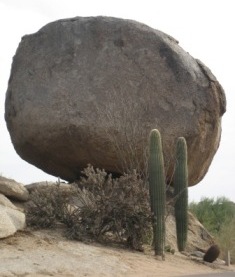
A boulder at The Boulders Resort in Arizona

It was also amazingly beautiful. The resort was built in 1985 on 1300 acres and according to one of the staff we chatted with, the architect spent weeks onsite, camping in various spots, in order to figure out how to situate its buildings and facilities. The end result is divine: everything is worked into the landscape–instead of interrupting nature, the buildings and sidewalks and access roads flow with it. You feel like you’re in a different world. At least this northeasterner did :-)

Anyway, here are some pics of the resort, starting with the main lodge. This is taken from across the fairway of the 6th hole of the resort’s south course. The lodge isn’t that far from the main north/south highway to the resort (Scottsdale Road/N. Tom Darlington) but you wind all through the resort to get to it. Then you leave your car with them–it’s valet all the way after that since you can’t access the rooms with a car.

The Boulders Resort lodge

Here’s what it looked like from our room when we woke in the morning.

The Boulders Resort view from our casita

We had a west-facing patio so the sun would light up that mountain every a.m. We were told we might see wild pigs, coyotes, and maybe a bobcat coming up through the wash back there, but we never saw anything bigger than a quail.

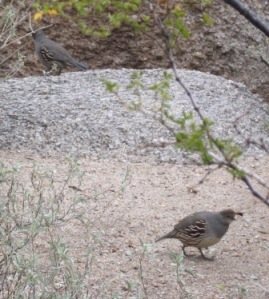
Speaking of quail, they were all over the place. Calling to each other constantly from alongside the fairways when we played. I never got a really good pic of them unfortunately. Once they realized you were approaching them, they’d quick dart behind a rock or bit of brush. Aren’t they cute, though, with their little feather pompadours?

Quail

I had better luck with the jackrabbits, especially this one, who sat still for me right next to our cart on our last day. They loooove the grass on the tee boxes.

jack rabbit

Here’s another view of one of the Boulders boulders :-)

Boulders Resort Nature trail

Isn’t that pretty? I took the shot from the resort’s nature trail, which loops around from the lodge to the courses’ club house and tennis courts and back.

Like I said, it was idyllic. As I write this post, we’re getting buried in the season’s first serious snow storm. Hard to believe that a week ago I was snapping a pic of a full moon, dressed in nothing heavier than a fall coat . . .

Full moon in Arizona

Now, give me a day or two, and I’ll post some more pics over at my golf blog. We tried four different area courses and I shot the best round of my life! :-)

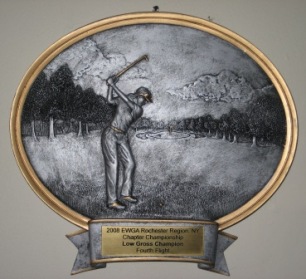
my plaque

Rochester region EWGA chapter tournament, played at Ravenwood yesterday. I shot a 101 and took low gross for my flight.

I’m a happy camper :-)

Cross-posted at Golfolicious.

With who, you ask?

It’s all revealed here.

I’ve been thinking more about Gallwey’s book and the implications of what he discovered about executing the golf swing.

Gallwey observed that there are two different “modes” of being that affect a golf swing. One is judgmental, critical, verbal, analytical. The other is kinesthetic and sub- or non-verbal.

It’s always tricky to describe different aspects of the self or psyche or personality. Gallwey was no dummy. He was writing in the 70s for an audience that hadn’t been acclimated to new agey-type material. So it’s no coincidence, I’m sure, that the terminology he coined to describe these two modes was pretty dry: Self 1 and Self 2, respectively.

As simple designations within the context of mastering a golf (or tennis) swing, that terminology works. But what about off the course?

“Self 2″ is a mode of being that is gained by intent, trust, and a shift to pure awareness — the same state we try to achieve during certain types of meditation. It’s the mode that we associate with “being in the zone,” where everything just flows effortlessly. There’s a kind of magic to it. Here’s a bit from the book:

Before I address the ball, I look at the situation and let Self 2 pick the target. I see the ball already there and convince Self 1 that the results are already accomplished. You might say that I pretend that the desired results have already occurred. This leaves Self 1 with nothing to be tense about or to doubt. It is the ultimate in the doctrine of the easy — what could be easier than to do something that has already taken place?

Now all that is left is to enjoy hitting the ball. In effect, I say to myself, Now that the ball has already landed where you want it, how would you like to have hit it there? Then I express the quality I want to experience by hitting the ball the way I really want to, allowing Self 2 to express himself to his full limits.

Within the scope of Gallwey’s work, this phenomenon resolves down to body vs. “head.” The body knows how to swing a golf club. The golfer must simply get his head out of the way so that his body can execute the swing unimpeded.

But anyone who’s looked at any of the “self help” literature published in the 40 years since Gallwey’s first Inner Game books will recognize this template. What’s more, it’s been applied — over & over — to activities that have nothing to do with sports. From Joseph Murphy and Neville Goddard up through Esther Hicks and Deepak Chopra, the advice is identical to Gallwey’s golf swing routine: set a goal, picture it accomplished, and then get out of the way and let the path to the goal unfurl.

What’s interesting is the terminology people use to describe “Self 2.” Murphy is one of many who use “subconscious.” Neville Goddard — perhaps reflecting how slippery this terminology becomes — sometimes fell back on metaphor but also used “Imagination,” “The Divine Body,” “the inner body” (in e.g. Awakened Imagination), “consciousness,” and the “I AM” (e.g. The Power of Awareness). Some writers go right to the heady mystery of it and ascribe to it Divinity (“let go and let God”). Others don’t bother with naming it at all, but focus on process.

Mulling all this over the past few days, the term I’m drawn to most, unfortunately, is “daemon.” Unfortunately because a daemon, to inheritors of the Judeo-Christian tradition, is a demon, aka evil disembodied creature best left well alone. Too bad we can’t rescue the word, at least in some form — revert back to how Socrates, for instance, spoke of his daimonion (“little daimon”) in terms of

“a divine or supernatural experience . . . It began in my early childhood — a sort of voice that comes to me; and when it comes it always dissuades me from what I am proposing to do, and never urges me on.”

That’s from Plato’s Apology, my Penguin Classics edition I picked up somewhere for two bucks.

Socrates was drawing on an older use of the word, as described here by Wikipedia:

The Proto-Indo-European root *deiwos for god, originally an adjective meaning “celestial” or “bright, shining” has retained this meaning in many related Indo-European languages and cultures (Sanskrit deva, Latin deus, German Tiw, Welsh [Duw],]), but also provided another other common word for demon in Avestan daeva.

In modern Greek, the word daimon (Greek: ??????) has the same meaning as the modern English demon. But in Ancient Greek, ?????? meant “spirit” or “higher self”, much like the Latin genius. This should not, however, be confused with the word genie, which is a false friend or false cognate of genius.

Socrates’ daimonion got him in a world of sh*t, of course, since the Athenians in power were nervous about people following their own little daimons instead of state-recognized gods.

Politics aside, to my thinking, the Socratic notion of daimon gets a little closer to the real nature of Self 2. Self 2 is more than mere body consciousness; it possesses an intelligence that is in many ways superior to that of Self 1, and capabilities that extend beyond mere physical acts. This explains why it comes into play in experiences that involve more than our bodies — that involve events and objects over which we have no direct physical influence. It explains as well its association with our blessings and success — one’s daimon serves as a midwife who delivers blessings into one’s life.

That said, I’m equally impatient with teachings (including a lot of Buddhist literature) that denigrate Self 1. Just because we develop habits of self-criticism that are against our best interests doesn’t mean Self 1 is an obstacle to be overcome or destroyed (!) — we are as wrong to demonize the ego as to demonize the daimon. Both were given to us by the source God, after all. Instead, we should view Self 1 as a kind of personal GPS: it feeds back data we need about where we are and whether our coordinates are to our liking, and identifies conditions that we can use for goal-setting.

The trick is to cultivate a partnership between these two “selves.” Ideally, Self 1 evaluates current coordinates and pinpoints suitable future coordinates. Then Self 2 — the daimon — guides us and executes the actions necessary to move us toward those coordinates.

That’s where the giddiness comes in, of course, because much of what the daimon does is invisible to the ego. So Self 1 has to chill out and trust that its goals will be met even though evidence of that fact might be in scarce supply. Faith as evidence of things unseen and all that.

What Gallwey discovered is that during this stage, we can fall back on simple awareness. This displaces our tendency to over-analyze or engage in constant verbal critiquing — mental activities that inhibit the daimon’s ability to do its work.

None of this gibes with official Christianity, of course, a discrepancy that Philip Pullman has tried to exploit with the His Dark Materials books. Too bad, really — Pullman is no doubt very bright, but a spiritual crank (c.f. his fixation with mischaracterizing the writings of a man who, being dead, can’t defend them. What a waste of fame.) Even without intellects like Pullman’s around to egg things on, however, I suppose it would take some time before we could return “demon/daemon/daimon” to its rightful usage — in fact, if I were a scholar I’d look for evidence that early Christian authorities took their position on demons right from the Athenian playbook. Persuade people to mistrust their inner voice and you make them dependent on your official pronunciations. It’s an old trick but we still fall for it, sorry, Socrates.

Or we keep our work beneath the radar by using terms like “subconscious” or “Self 2″ — words that are safe precisely because they don’t evoke the real mystery and power that is there for us to explore — if we dare to trust how close we really are to the divine . . .

(Crossposted at Golfolicious.)

Last fall, around the time it got too cold to golf anymore, I was feeling pretty discouraged about the game.

It seemed to me that after a year & a half of playing I should have been getting better. Ha. I was as close to breaking 100 at the end of 2006 as I was last fall. What’s worse, my swing was still a mystery to me. I couldn’t really understand what made it work or not work.

I’m slowly beginning to understand the mechanics. Slowly because there’s so much to it. This is nothing other golfers don’t already know, but for a golf swing to work, it has to be incredibly precise. A teensy spot on the face of the club has to hit a teensy spot on that little golf ball at precisely the right angle and velocity. And for that to happen, muscles throughout the body, from the pads of the feet through the core to the fingertips have to coordinate their movements within miniscule tolerances. It’s hard.

Or is it? What’s been maddening me is that I’ve always been able to hit the ball well sometimes. Incredibly long straight drives or perfectly gorgeous iron shots — pitches that arc up, drop near the hole and stick. Maddening, because if I could do it once, you’d think I could do it over and over.

Anyway, I finally returned to an old “friend,” Timothy Gallwey. I’d read his book The Inner Game of Tennis when I was in high school — I wasn’t a tennis player but somebody (was it you, Dad?) recommended it — I applied it (as best a self-conscious teenager could) to my basketball game.

This time, natch, I’m reading The Inner Game of Golf.

Here’s an Amazon affiliate link, so if you want to buy a copy I’ll get, um, 15 cents or something.

My copy is the 1981 hardcover edition btw, which means I got this “screamin’ 70s” pic of Gallwey on the back cover.

Tim Gallwey

I don’t want to write too much about this yet, because doing so might make it harder to apply what I’m learning. But. The basic idea is that for a golf swing to really work there has to be an element of surrender. The “I” self that lives here, on the surface of things, has to take a back seat and allow That Something Else to swing the club.

I managed to do it fairly well on Monday — I played with my folks at Victor Hills East. What happened was almost spooky, in fact. I set my goal as “no more than 6 strokes per hole.” For the first three holes I got exactly 6 strokes on each hole (double bogeys on each). I was laughing at myself for meeting my goal so literally.

The next two holes are both par 3s; I shot a 5 and a 4 on them.

It was around the 6th hole that my concentration started to wobble a bit; I began to pay the wrong kind of attention to my game (“oh wow, I’m in the running to break 50″ kind of thinking) — shot an eight on 6 and a seven on 7.

And I realized: I just offset holes 4 & 5 so that my average is: 6 strokes a hole!

I bogeyed the next two holes, par 4s, to finish the front with 52 — not great, but a good 10 strokes lower than what I would have shot a week ago.

It didn’t last. I lost my focus through most of the back 9, regaining it only on 17 (parred with 3 strokes) and 18 (par 5–bogeyed it). So my overall score was still higher than I would have liked. But I don’t really mind. When I took up this game again 23 months ago I did it in part because I wanted a competitive physical activity that I could pursue until I drop dead. But there was another reason: I wanted to apply what I’ve learned about Mind — learned since I was that self-conscious teen — to an activity that would feed it back to me in near real time. It could have been martial arts or something, but it’s golf. Now to see how far I can take it . . .

Next Page »