
:-)
Thanks to all who have stopped by this blog — and best holiday wishes to you . . .
(Ecard courtesy someecards. Check it out if you haven’t ever visited!)

:-)
Thanks to all who have stopped by this blog — and best holiday wishes to you . . .
(Ecard courtesy someecards. Check it out if you haven’t ever visited!)
Break in posting because I spent a few days over last weekend on a delightful golf vacation in Carefree, Arizona — a bit north of Scottsdale.

It was idyllic. We stayed at The Boulders Resort, and I’ve never felt so pampered in my life. Turns out that was no accident. I flipped through some literature about the resort in our room (excuse me, our “casita”–the guest rooms are freestanding adobe buildings linked by winding sidewalks, and accessed by golf carts rather than cars) and it described the resort’s service philosophy. They’ve got a detailed service credo and everyone who works there goes through extensive training, including role playing so they’ll know how to handle guests’ needs. It sure shows. Right from the little things, like the way all the staff greet you by name and make lots of eye contact. You really do feel like a guest, not a customer.

It was also amazingly beautiful. The resort was built in 1985 on 1300 acres and according to one of the staff we chatted with, the architect spent weeks onsite, camping in various spots, in order to figure out how to situate its buildings and facilities. The end result is divine: everything is worked into the landscape–instead of interrupting nature, the buildings and sidewalks and access roads flow with it. You feel like you’re in a different world. At least this northeasterner did :-)
Anyway, here are some pics of the resort, starting with the main lodge. This is taken from across the fairway of the 6th hole of the resort’s south course. The lodge isn’t that far from the main north/south highway to the resort (Scottsdale Road/N. Tom Darlington) but you wind all through the resort to get to it. Then you leave your car with them–it’s valet all the way after that since you can’t access the rooms with a car.

Here’s what it looked like from our room when we woke in the morning.

We had a west-facing patio so the sun would light up that mountain every a.m. We were told we might see wild pigs, coyotes, and maybe a bobcat coming up through the wash back there, but we never saw anything bigger than a quail.
Speaking of quail, they were all over the place. Calling to each other constantly from alongside the fairways when we played. I never got a really good pic of them unfortunately. Once they realized you were approaching them, they’d quick dart behind a rock or bit of brush. Aren’t they cute, though, with their little feather pompadours?

I had better luck with the jackrabbits, especially this one, who sat still for me right next to our cart on our last day. They loooove the grass on the tee boxes.

Here’s another view of one of the Boulders boulders :-)

Isn’t that pretty? I took the shot from the resort’s nature trail, which loops around from the lodge to the courses’ club house and tennis courts and back.
Like I said, it was idyllic. As I write this post, we’re getting buried in the season’s first serious snow storm. Hard to believe that a week ago I was snapping a pic of a full moon, dressed in nothing heavier than a fall coat . . .

Now, give me a day or two, and I’ll post some more pics over at my golf blog. We tried four different area courses and I shot the best round of my life! :-)
Several blogs, including Instapundit, The Volokh Conspiracy, and JustOneMinute have picked up Nicholas Kristof’s Dec. 4 piece in the NY Times that calls attention to the problem of iodine deficiency in third world countries, such as Pakistan.
I’ve just been reading a 2006 paper by Stephen A. Hoption Cann, PhD, published by the American College of Nutrition, Hypothesis: Dietary Iodine Intake in the Etiology of Cardiovascular Disease which states that the “proportion of the US population with moderate to severe iodine deficiency (<50 µg iodine/L in urine) has more than quadrupled in the last 20 years.”
That’s right here at home, people.
I posted in August about my own experimentation with iodine supplementation. Today I typically take 25 mgs/day — thousands of times the RDA — and the results have been incredible. Now that winter’s here, for instance, I’ve noticed I don’t get cold as easily, and my skin doesn’t feel dry and itchy like always has in past winters. And of course, the fibrocystic breast tissue that was with me since my 20s is completely gone.
I’m a believer. I’ll never stop taking the stuff.
I just hope other people catch on & start taking it too.
What I find most fascinating about the whole subject is that iodine is so critical to so many of the human body’s biochemical systems that you have to wonder: how pervasive is the impact of our epidemic of iodine deficiency?
Obesity is an obvious candidate for thought. It began taking off in the United States during during the late 1980s. That corresponds pretty closely to the 20-year timeframe cited in Cann’s paper.
Some of that is probably because we no longer get any iodine from bread. The FDA “explicitly approved bromate for . . . use in bread through the standards for bread and rolls promulgated in May of 1952.” One of the flour conditioners potassium bromate displaced, with the FDA’s blessing, was potassium iodate.
Another likely factor is that we’ve been instructed to reduce salt intake. When we’re urged to cut back on salt (which the National Research Council was doing as far back as 1989, and probably further — I remember my grandfather being told not to eat salt in the 1970s) then we’re not necessarily eating enough iodized salt per day to get even the RDA for iodine.
Then there’s this: does the salt you sprinkle on your pommes frites provide as much iodine as it’s supposed to? See this e.g. (translated I think from French — but you’ll get the gist) (Update: Link no longer works, sorry):
Iodine content of reference iodized salt was 38.53?6.92 on June 1997. After the salt was stored at room temperature with a relative humidity of 30 % -45% and in sealed paper bags for three years, iodine content changed to 18.25 ??4.72. Thus 52.63 % of was lost in approximately 3.5
years. This means that standing time and storage conditions is very effective storage of iodine in food.Cooking conditions is very effective on the stabilization of iodine. In the case of oxidants in diet loss of iodine is more effective, 82% of iodine may lost during the high temperature cooking oxidized medium. So it is advised to consume iodide to put the food not before the cooking after the cooking. On the other hand, if consuming of iodide not advised to people who have problems with their thyroid, long term treatment at oven with an mild oxidant may loss 81% of iodine and 55% of iodine without an oxidants.
Less obvious is iodine’s role in other bodily systems that aren’t obviously linked to the thyroid.
Like heart disease, for instance.
That Cann paper I linked up top explores the correlation between low iodine levels and cardiovascular disease. Talks about selenium as well, another nutrient that’s deficient in our diets.
Here’s a taste:
Uotila et al. [18] made the observation that subjects who died from coronary sclerosis often had goitre. In order to further examine this phenomenon, 250 Finnish subjects who had died from coronary heart disease were age and sex-matched to controls who died from other causes [19]. The risk of death from coronary heart disease was found to be significantly higher in individuals with goiter (odds ratio (OR) = 3.53, 95% confidence interval (CI) 2.43–4.99). It was noted that the average thyroid weight was higher in those dying from coronary disease. Moreover, among the coronary disease cases with goiter, there was a lower average age of death and a higher average heart weight. Due to the low iodine content of foods and lack of an iodization program at the time, endemic goiter was common in Finland, particularly in the east.
Well worth clicking through to read the whole thing. Good Sunday eve reading ;-)
The point Kristof tries to make in his NY Times article is that nutrient supplementation makes for boring public policy. He is referring to foreign aid/humanitarian policy, but the same is true right here at home. We’re happy to pour billions of dollars into breast cancer research, for instance (the Susan G. Komen for the Cure foundation alone has spent $1 billion over 25 years). And there’s nothing wrong with that. But where’s the enthusiasm for using iodine supplementation to prevent breast cancer? It’s not there — not on anything like the pink-ribbons-everywhere scale of mainstream breast cancer campaigns — because it’s such a prosaic and unpatentable approach.
But think about it.
Iodine supplementation may well be an very inexpensive way to address a whole range of very costly health issues that are faced by a huge majority of Americans.
What would become of the “healthcare crisis” if that proved to be the case?
Having watched West Side Story a few weeks ago, I came down with a severe relapse of the Shakespeare bug and so last night sat down and re-read Romeo and Juliet. I wanted to see how closely the movie followed the play.
Answer: yep, very closely. I’m sure this has all been written out before, so I won’t turn this post into an OMG!!! sophomorish comparative lit paper (at least not on that topic, heh) but suffice to say that about the only major differences were in the whole fake-my-death-in-a-doomed-ploy-to-be-reunited-with-my-lover device.
If you’re a lit nerd like me, it is kind of fun to enjoy the two side by side — to see how famous dialogue like “a rose by any other name” is handled in the musical. Try it, and do enjoy ;-)
Another thing struck me as I mulled the play, however.
This has probably been remarked before too but I’m going to work it out for myself anyway.
I published a post some time ago about how, in rereading Anna Karenina as a nominally-mature adult, I found it to be a different book than I once thought. It isn’t a starry-eyed celebration of doomed love — it’s a condemnation of weak character. Anna’s a deeply flawed individual, not a one-dimensional victim of social repression.
I had a similar reaction last night to Romeo & Juliet. The first tip-off was something I’d completely forgotten: that when we first meet Romeo, he’s a complete mess over another woman, fair Rosaline.
Huh?
The man has, apparently, been pining away for some time because Rosie doesn’t love him back — spending every night wandering around outdoors, weeping & sighing, and then shutting himself inside all day with the curtains drawn to make himself “an artificial night.”
Then, after spending an entire day insisting that he’ll never get over her, he meets Juliet — and within about a nanosecond is as smitten for her as he ever was for Rose.
I found that odd. What sort of true-hearted hero is this, Bill? Whose heart can veer so suddenly and violently (and unselfconsciously!) from one love to another?
Of course Shakespeare renders the love between Romeo and Juliet a beautiful thing. Heart-wrenchingly beautiful. Clearly he means to hold it up as a romantic ideal of sorts.
But there’s another critical layer to the story that I noticed after a bit: the consequences of the lovers’ extraordinary passion are every bit as destructive as the passionate “choler” that erupts whenever lesser members of the Montague and Capulet families run into each other in the street.
It seems to me Shakespeare creates an obvious parallel between the two. Romeo and Juliet never try to temper their passion with anything like common sense, let alone reason. They marry the day after they meet, for crying out loud — and in Act III Scene 3, after Romeo is banished from Verona by the prince for murdering Tybalt, it’s only the Friar’s scolding that stops Romeo from killing himself:
Art thou a man? thy form cries out thou art —
Thy tears are wom’nish, thy wild acts denote
Th’ unreasonable fury of a beat.
Unseemly woman in a seeming man,
And ill-beseeming beast in seeming both,
Thou hast amaz’d me.
Get ahold of yourself, you ninny. The Prince has spared your life. You can bide your time and be reunited with Juliet by and by. It ain’t the end of the world.
Romeo calms down, but of course it’s only a prelude to yet another slew of rash acts that culminates with the final bloodbath.
It’s a marvelous thing, then, the way Shakespeare handles the first murder in the play. Do you remember it? There’s a street brawl, and Tybalt stabs Mercutio. But what’s interesting is that Tybalt does so by using Romeo’s body to hide from Mercutio the fatal thrust of his rapier.
Romeo he cries aloud,
‘Hold friends! Friends, part!; and swifter than his tongue
His agile arm beats down their fatal points
And ‘twixt them rushes; underneath show arm
An envious thrust from Tybalt hit the life
Of stout Mercutio . . .
This layer isn’t brought out in the same way in West Side Story. WSS is played, first of all, as a straight “star-crossed lovers” story — Tony has matured, he’s not hanging out on the streets any more, he’s got a job — but then he’s drawn back into the gangs’ fighting by his love for Maria, becoming a victim of the violent subculture he’d tried to leave behind.
And, in keeping with that trajectory, the circumstances of the first murder are subtly different: Tony holds Riff back from stabbing Bernardo, and Bernardo takes advantage of that to stab Riff.
It’s a subtle difference but a telling one. Tony is playing pacifist, physically restraining Riff. Romeo is also trying to break up a fight, but he functions as an unwitting screen behind from which comes the deadly thrust.
“Why the devil came you between us?” Mercutio asks Romeo before he dies. “I was hurt under your arm.”
Romeo’s read of the situation was naive –just as was Tony’s — and on the level of pure plot, that’s why the story turns tragic.
But in the Shakespeare, Romeo’s arm cloaks Tybalt’s — they become in that moment the same arm. So it isn’t just the street brawlers who are in the words of the Prince (Reason and Justice) “enemies to peace” . . .
Incidentally, if your library lacks a collected works of Shakespeare, I highly recommend you look for the marvelous but sadly out-of-print edition, The Yale Shakespeare
The beauty of it: it’s broken into 40 slim volumes. Here’s my Romeo and Juliet.

It’s 4X7 inches — light enough to hold open with one hand.
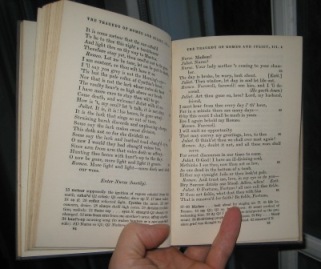
I have no idea if it’s considered up-to-par today from a scholarly perspective (my edition was published in 1954; the original came out in 1917) but it’s annotated to help with the more archaic bits.
And from an ease-of-use standpoint, it’s pure genius. When publishers shove Shakespeare’s complete works into a single volume, you end up with a book that is hugely unwieldy (and with paper that is thin as tissue to try to keep the weight down). Who wants to lug a 20 pound doorstopper around when all you want to do is read R&J while you’re parked in the dentist’s waiting room?
The Yale Shakespeare is kind of pricey (link above to Amazon has a couple sellers offering the complete set for $75 as of right now) but it’s well worth it, in my opinion.
Would be nice to see a re-issue. Wonder if it could be done for under $75 . . .


