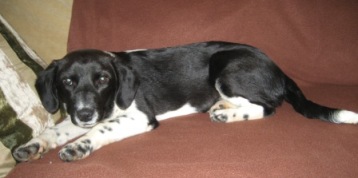
I’ve lived with three dogs in my life. The first was Biddy, the dog we had when I was growing up. I’ll let my dad blog about her if he likes–she was his dog, and he used to hunt with her–but suffice to say, she was a dream dog: gentle and smart. An English springer mix, black and white, slender and more slope shouldered and more mellow than show Springers.
My next dog was a Dobie mix I picked from a litter of puppies in Vestal, New York, when I was 19 years old. I had her for 14 years, living off-campus while I got my BA so that I could have her with me, and on through the ensuing years, through many moves, some important relationships with (thankfully dog tolerant) people. She was a wonderful dog in many ways as well: strong, relentlessly upbeat, absolutely devoted to me. She was also a highly active dog, and when circumstances found me moving from the country to the burbs, the adjustment we had to make was a jarring one. I didn’t even own a leash for the first 10 years of her life, for instance. Let alone have a clue how to train a dog to walk on one.
Laykey was my crude attempt to find a dog who would fit better into a suburban environment. Corgis were bred as all around farm dogs–yes, for herding, too (droving, to be precise)–but they don’t have that need for hours of high-intensity exercise of say a Border Collie. They were more general purpose dogs. (And tell you what, nobody could come anywhere near my house, when Laykey was alive, without my knowing it. She raised plenty of false alarms [SQUIRREL ON THE PORCH! SQUIRREL ON THE PORCH!] but that’s an acceptable trade-off, IMO, for knowing I had a keen extra set of eyes & ears watching my property.) Corgis were bred to stick around the house, keep an eye on things, push the stock around once in awhile if asked to, lay low otherwise. Literally ha ha ha.*
So I knew Laykey would be happy in a world where leash walks, not hours-long rambles in the woods, counted as exercise–and I was right.
Where I missed the dingy was in considering other aspects of temperament.
Some might say that my fundamental error was in picking a purebred dog, and in some respects that’s a valid assumption, although not for the reasons most people have in mind. When I handed that substantial sum of money to her breeder, I rather thought it would buy me a certain sort of experience. Silly me.
I still believe that finely bred dogs can be excellent companion animals–it wasn’t the purebred/mutt choice that got me, but the lack of guidance. Laykey’s parentage didn’t let me down–her breeder did.
That said, I’m not going to do a purebred next time. Or I should say, purebred isn’t the spec. I’m going to choose my next dog by the company she keeps. I’ve begun, already, by looking into a couple different local rescue groups, and in a more-or-less random act, picking Black Dog, Second Chance. There are others, and if you’re looking for a dog, check Petfinder, you’ll find some in your area as well.
Here’s why I’m doing this. First, by working with a rescue organization I’m supporting people who place dogs that would otherwise, quite likely, be euthanized. So there’s the doing-the-right thing aspect. (This particular group focuses, although not exclusively, on black dogs, because they tend to be harder to place; according to their website, black dogs on average languish in shelters three times longer than light-colored dogs–which, if it’s a “kill shelter,” is tantamount to a death sentence.)
Another plus: rescue organizations, at least ideally, are staffed by people who want their dogs to be a good fit with the people who adopt them. This isn’t about finding a home, any home–this isn’t a game of “you touched the dog last, now he’s your responsibility.” BD,SC isn’t going to try to persuade me to take a dog that I’m not 100 percent comfortable committing to–in fact, I have the option of fostering a prospective adoptee for a week or two to see if she’s a good fit. That’s advantage number three. Even if I don’t ultimately adopt a particular dog, Ill be contributing by giving someone else’s future canine buddy a place to camp for awhile. I don’t have to feel badly, no matter what the outcome–I’m doing the dog a good turn.
I feel good about this.
There’s the issue of timing. Laykey hasn’t been gone very long. I still find myself expecting to see her. Expecting her to pounce, thrilled, on a bit of lettuce I’ve dropped on the floor. (Lettuce, really!)
I still get weepy over her–I saw one of my nextdoor neighbors for the first time since Christmas yesterday, and broke up when I told her Laykey is no more.
On the other hand, there are dozens of dogs in the Rochester area who need homes. And I want a dog. And when it comes down to it, I don’t think it’s disrespectful to take another dog in while still mourning a bit. One doesn’t take away from the other.
So if the right dog becomes available, I’m going to move on it.
I’m making a few preparatory arrangements. The most important: I’d been considering, for years, fencing in a portion of my yard–not for “dog storage” but as a place for supervised play and off-leash training.
Laykey would have adored it.
Add that to my regrets . . .
I’m not going to make the same mistake twice. I’ve gotten a quote and it’s a reasonable one, and being winter it shouldn’t take long to get the work done.
It means I’m giving up, for the next few years, my other fancy–the backyard vegetable garden. But I’ve lived without a garden for a long time now; I can manage a little longer. And if I don’t put in the garden, there’s no need to remove the massive silver maple someone planted smack dab in the middle of my back yard 50 or 60 years ago–little realizing it would one day render that space unusable for anything except . . . maintaining a massive silver maple.
But. It is a big old tree, a certain Englishman voted last summer to spare its life, and it’s got this huge leader (think “a second trunk that starts partway up”) that is dead–and the woodpeckers love it. There was a red-bellied woodpecker on it just the other day, when I walked back to consider it again.
An arborist took the same walk with me today and agreed the leader isn’t particularly dangerous–if I want to leave it for the woodpeckers, I should leave it for the woodpeckers.
Good. The tree stays, the garden idea gives way to the doggie play yard idea, and the woodpeckers will give my next dog something to bark at. If she’s a “looking up” sort of dog. My Dobie mix used to look up–if I said “birds!” she would look up and bark at birds flying overhead. Silly dog.
I can’t imagine living without a dog.
*This is a “Corgi’s got short legs” joke . . .