Archive for August, 2007

Yes, replacing aging bridges before they fall apart is important. But in some cases that means we’re losing bits of history, not to mention personality to yet more dull old concrete.

I wish I’d gotten pictures, for example, of the old Hoxie Gorge bridge on Route 81, near Cortland, N.Y., before it was demolished last fall. I can’t even find any stats on how high it was (some locals nicknamed it “the mile high bridge” though, to give you an idea of how high it seems when you’re on it). It spans a gorge along the Tioughnioga River valley. It’s being rebuilt now and will be safer as a result, of course. Before we’ve lost that gorgeous arched steel forever, and nobody seems to have noticed.

I did take the time yesterday to get some pictures of the bridge across the Chenango River in the town where I grew up, Oxford, NY, because this one is slated for replacement as well.
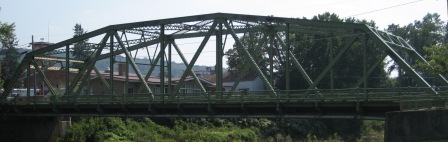
Bridge over Chenango River in Oxford, New York, Burr arch truss design

Just another backwater steel bridge, yeah, I know.
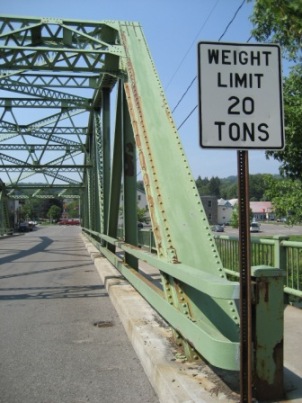
Chenango River bridge in Oxford New York, Burr arch truss design

It’s got a connection to Oxford beyond just the practical, however. The design uses a “Burr arch truss” that was invented by Theordore Burr — a cousin of Aaron’s — who was an Oxford, NY native around the turn of the 19th century. Burr’s design made our bridges strong enough to support heavier vehicles, including trains. He built the first bridge across the Chenango in Oxford and also a gorgeous house which, today, is the town library.
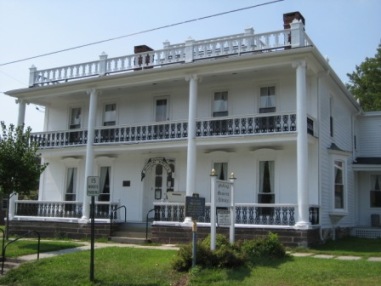
Oxford New York Public Library, Theodore Burr house

From the piece linked above:

The “Burr arch truss”, used two long arches, resting on the abutments on either end, that typically sandwiched a multiple kingpost structure. Theodore Burr built nearly every bridge that crossed the Susquehanna from Binghamton, NY to Baltimore, MD in those days. His successes made him the most distinguished architect of bridges in the country. Today’s modern bridges with their graceful arches can be traced back to Theodore Burr and his contemporaries.

In April, 1818, he advertised in the Oxford Gazette, that he had “devoted eighteen years of his life to the theory and practice of bridge building exclusively, during which time he had built forty-five bridges of various magnitude, with arches from 60 to 367 feet span.”
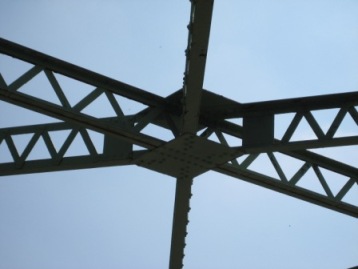
Bridge over chenango River, Oxford New York, Burr arch truss design

Back in those days, small towns didn’t carry the stigma (often undeserved of course) of being home to small minds. It was perfectly in keeping with the vision of the time to found an Academy here, for instance — it was expected that the best and the brightest would be out in “the wilderness” and would look for ways to get a classical education.

Oxford Academy

The building is the town’s middle school today. For now. It’s on the river flats, and was flooded badly last year. The town isn’t sure they’ll be able to fund insurance on it any more — and so it may well be junked in exchange for some cheaply built ugly modern thing. Hopefully someone will find some other use for the building. It’s a treasure, but unfortunately small town upstate NY resources don’t always allow the luxury of preserving treasures.
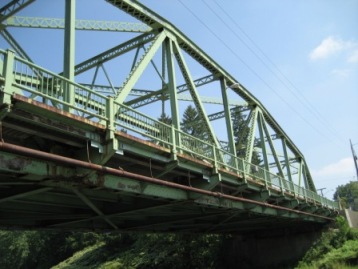
Bridge over Chenango River in Oxford New York, Burr arch truss

Technorati Tags: , , , ,

John Boyne, who caddies at the Old Course at St. Andrews, posted this on The Golf Space — which you should definitely check out if you’re a golfer ;-)

I thought it was lovely, which shows you how far gone I am — the game’s even seeping into my bookly side, lol

Of course that may have something to do with the fact that I took another lesson yesterday, during which the pro who’s coaching me completely changed my swing. No threes for me again for awhile, I’m afraid!

Seaside Golf

by John Betjamin

How straight it flew, how long it flew,
It cleared the rutty track
And soaring disappeared from view
Beyond the bunker’s back -
A glorious, sailing, bounding drive
That made me glad I was alive

And down the fairway, far along
It glowed a lonely white;
I played an iron sure and strong
And clipped it out of sight,
And spite of grassy banks between
I knew I’d find it on the green

And so I did, it lay content
Two paces from the pin;
A steady putt and then it went
Oh, most securely in.
The very turf rejoiced to see
That quite unprecedented three.

Ah! Seaweed smells from sandy caves
And thyme and mist in whiffs,
In-coming tide, Atlantic waves
Slapping sunny cliffs,
Lark song and sea sounds in the air
And splendour, splendour everywhere.

More golf blogging by me at golfolicious.com.

Technorati Tags: ,

“I ONCE HAD A GIRLFRIEND WHO QUIT JOURNALISM and went into P.R. because she said public-relations work was ‘more ethical.’”

lol

That’s an Instapundit lead-in to a link to this piece, about journalists cheating on an online poll.

As a PR professional, I will say this — about my firm, anyway.

First, our advocacy, when we go to work for our clients, is at least out in the open.

And second, we take credibility seriously, because we have to — if we lose it, our clients get upset with us and we stop making money.

Journalists, otoh — the bad eggs, anyway — seem to think more short term. “If I write a good fake story it will get me a full-time gig at this magazine/win me a Pulitzer/save me having to run around doing actual research.” Forgetting that, ultimately, their shenanigans paint everything it touches with a big ol’ tarnish brush.

Technorati Tags: ,

That was awesome — I just did a radio interview about Outwitting Dogs for WBER, Rochester’s alt music radio station. What a kick. Thanks Joey & Sgt. Pepper!

Anybody who stops by, the book is available on Amazon.

Other resources I mentioned on the interview. If you’re looking for a Rochester area trainer, Cindy Harrison at SeeSpotThink is terrific. (Many of the photos in 101 Dog Training Tips were taken during classes at her training facility here in Roch.)

Terry Ryan, the trainer who was the real brains behind Outwitting Dogs, is online at Legacy Canine.

Feel free to email me (address on the right) if there’s anything else.

(I also have another blog, www.golfolicious.com, for my other obsession ;-))

Technorati Tags:

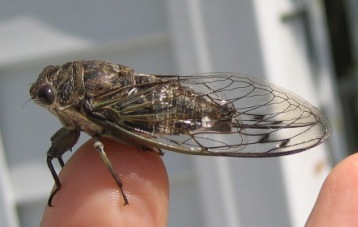
CicadaMy daughter & nephew found this cicada on my parents’ pool deck this morning. It was sluggish from the cold so I was able to hold it for quite awhile to photograph it, until it got warm enough from the sun to fly off.
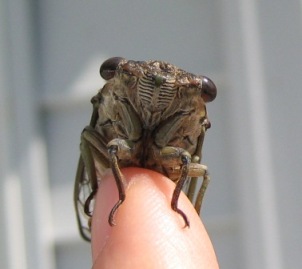
I’ve been fascinated by cicadas since I was a kid. Those wings — aren’t those amazing wings? And the huge sound they make — you can’t help but know they’re all around — yet you hardly ever see them, they hide so far up in the trees.

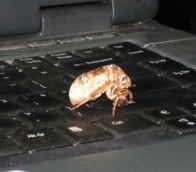
(Although you can easily find the husks of the nymphs. Here’s a pic of a husk my daughter found a few weeks ago — not a great pic because I took it tonight, so the flash is going off.)

cicada nymph husk

As I started this post, I thought maybe I could figure out what species of cicada I’d photographed today, but no luck — it doesn’t look much like the photos I found of various species online. It also turns out there are a loooot of different kinds of cicadas — 100 species in North America alone, 2500 worldwide. About all I can figure is that it’s probably a dog day or annual cicada, not a periodic cicada.

I thought this was interesting, too:

Cicadas are unique in sound-producing insects in that they have a musical drum in their abdomen. The organs that produce sound are ‘tymbales’ ~ paired membranes that are ribbed and located at the abdominal base. Contracting the internal tymbal muscles yield a pulse of sound as the tymbals buckle inwards. As these muscles relax, the tymbals return to their original position. The interior of the male abdomen is substantially hollow to amplify the resonance of the sound. The song intensity of the louder cicadas acts as an effective bird repellent. Males of many species tend to gather which creates a greater sound intensity and engenders protection from avian predators.

In addition to the mating song, many species also have a distinct distress call, usually a somewhat broken and erratic sound emitted when an individual is seized.

One summer –it must have been in the 70s — while we were visiting my paternal grandparents in Germantown, New York, I happened to be out in the yard when I heard a racket in the air — a cicada killer wasp had attacked a cicada; they were grappling midair like two monsters in a Godzilla movie, the cicada buzzing noisily — the sound was recognizable as a cicada buzz but at the same time it didn’t sound at all like when they call from the trees. “Broken and erratic” for sure.

I guessed what was going on — I’d probably read about cicada wasps in Ranger Rick or someplace.

It’s one of the pleasures of summer vacation for a kid though, isn’t it? To spend all that time hanging around “not doing anything,” and as a consequence catching things like that — like a cicada wasp seizing a cicada. It’s not even that such things are so uncommon, either, just that you have to be in the proverbial right place/right time.

Anyway. A few more weeks of cicadas singing yet, before the summer’s done. Happy dog days. Good night.

cicada face

Technorati Tags:

Instapundit linked to this piece in Popular Mechanics which begins

Yesterday’s tragedy makes it clear that the U.S. has been squandering its infrastructure legacy by turning a reckless blind eye to critical upgrades . . .

I don’t know about you, but I’ve suspected as much.

The plain fact is, an awful lot of our infrastructure is OLD, if not ancient, and in the back of our minds, we know it’s in trouble. How can we not, when the news keeps nudging us, tap tap tap, with little reminders?

So you have near-tragedies, like what happened here in Rochester last year when a parking garage ramp collapsed. You have mini-tragedies, like that steam pipe explosion in New York City last month. You have seasonal tragedies, like the short-circuiting electrical systems that are zapping dogs and pedestrians as we walk our streets.

The sad thing is, it took something of the scale of the Minnesota bridge collapse to wake people up.

What’s even sadder is that just because we’re awake doesn’t mean we’ll act like adults about it. I’ve already seen one comment in a thread about the bridge that blames Bush for it — the poster claims that had he not invaded Iraq, all that money we spent over there would have been used to repair bridges.

We need to wake up. There are two reasons nobody is taking care of our roads, and bridges, and underground pipes and electrical circuits.

The first is that we, the American people, aren’t taking responsibility for it. The best analogy is to compare it to owning an older home. You can’t just buy a house and figure the only think it will cost you is your mortgage payment. You’re going to have to budget for periodic repairs, and sometimes those repairs are going to cost a lot.

We should all be thinking that way about our national infrastructure. We should be looking at our roads, and bridges, and electrical grid, and thinking, “this is a huge and complicated and important thing, and it will naturally cost us billions in upkeep.”

We should recognize that THIS is a top, top priority at federal, state, and local levels — not subsidizing charity or designating National Pea Splitting Day or appointing special prosecuters because Senator Johnny called Senator Suzy a bad name in the hallway. Or building ugly performing arts centers that will continue to drain away our resources on non-essentials for generations to come.

The second reason we’re in the shape we are is that we have elected idiots to Congress. It’s Congress, not the President, who decides where to spend our money — OUR money — and what they do with it, if you haven’t been paying attention, is sneak it off, in complete secrecy, and give it to their friends and political supporters for totally bogus projects.

Argue if you want that our foreign policy is misguided, but right here at home, John Murtha has just grabbed 48 earmarks in the 2008 defense spending bill — totaling $150.5 million. Altogether, there are 1,337 earmarks in that bill — 3.07 billion dollar’s worth.

That’s our money. But don’t bother asking for an accounting of it — because as far as Congress is concerned, it’s THEIR money.

Meanwhile, according to the PM piece I linked above:

According to a report card released in 2005 by the American Society of Civil Engineers (ASCE), 160,570 bridges, or just over one-quarter of the nation’s 590,750-bridge inventory, were rated structurally deficient or functionally obsolete.

It’s time we made it clear to Congress that the state of our infrastructure is unacceptable — and that we want our tax money to be spent on things that really matter. The corruption and theft of our money has to end.

Technorati Tags: , ,