Books that are really ideas

Via a comment on Ann Althouse’s blog, I skipped over today to this review in the London Times of an essay titled Comment parler des livres que l’on n’a pas lus (How to discuss books that one hasn’t read), which was written by one Pierre Bayard, who is a professor of French literature at the University of Paris VIII. And also (writes the reviewer, Adrian Tahourdin) a “practising psychoanalyst.” How beautifully French.

Bayard’s droll conceit includes a description of the four categories into which he places books:

“LI” is livres inconnus (books he is unfamiliar with); “LP” livres parcourus (books glanced at); “LE” livres dont jai entendu parler  (books he has heard discussed) and LO les livres que jai oubli (books he has read but forgotten).

Tahourdin next recounts that James Joyce’s Ulysses falls into the category LE.

[Bayard] claims not to have read the novel, but he can place it within its literary context, knows that it is in a sense a reprise of the Odyssey, that it follows the ebb and flow of consciousness, and that it takes place in Dublin over the course of a single day. When teaching he makes frequent and unflinching references to Joyce.

I suppose we should delight in his honesty.

I also wonder . . . hmmmm . . . what do his students think?

I’m afraid I can’t relate. Having attended a modest state college, I’m reasonable certain that my lit professors had actually taken the trouble to read the books to which they had the habit of making “frequent and unflinching references.” An alarming lack of pretension, I agree. But I forgive them.

Another thought also occurs to me. What does it say about a literary novel when People Who Read Serious Books can sum it up in a single sentence — sum it up as an idea — without even having to read it — and then discuss it, as that idea, amongst themselves?

Where are its roots?

Michael Blowhard wrote this, a couple of days ago, in a post about mystery writer Elizabeth George:

When you pull an artform out of the earth it grows from, even if you do so with the best or the loftiest of intentions, it’s likely to whither and then die.

I’m not sure we can accuse Joyce of yanking literature out of the earth — I think he was just marchin’ to the beat of his own drunken Irish drummer — but in the end he didn’t need to even if he’d wanted — he has the Bayards of the world to do it for him . . .
“Don’t blog if you’re boring”

That’s been my motto lately. Because I’ve felt like I’ve been pretty boring. At least on the outside, lol

It’s not that I haven’t been busy. I’ve been reading a ton of books — all kinds of interesting books — like I just finished-but-one-story “The New York Stories of Henry James” — which I picked up while in NYC of course. Only I haven’t felt inspired to blog about it — more fun to immerse myself and not assume the arm’s-length relationship that writing about it would require.

I’ve been working on revising my last-novel-but-one, which like my most recent novel got some passing interest from agents but wasn’t good enough to get anything more.

It’s been a painful process, the revision, because I’ve been confronting my own . . . naivete, if I want to be nice about it — incompetence, I think to myself in my less rosy moods. How could I have written so stupidly and not realized it? Sigh. Writing novels is without question the most difficult thing I’ve done, ever. Having to do major surgery well after I’d hoped The Thing Was Done only brings that point home all the harder.

I’ve been golfing a bit more lately, which has been nice. Will blog about that some more in the next few days.

And I’ve been writing for another site I’ve launched, WomenGolfApparel.com. I undertook this venture as an experiment: can I monetize my writing by creating a content-rich site and then run Adsense ads? I’m happy to say results so far are promising, although it has nowhere near the traffic I’d need to, you know, buy that nouveau-Italian palazzo-style McMansion with the the spinning hot tub in the back yard that I’ve had my eye on. ha ha ha

But it’s been fun, and IMO satisfies a real need, also. Especially if you don’t live in a major market, finding fun, stylish golf apparel — if you’re a woman — can be a pain. Many pro shops don’t carry much women’s clothing (due in part to their general focus on male golfers, but also because women’s shopping habits are different, according to an acquaintance who ran a pro shop with her husband for awhile. Men do things like notice it’s raining and buy a raincoat on their way out to the first tee. Women want to shop shop — and don’t combine that with their trips to the course to play.)

Even general sporting goods stores like Dick’s shortchange the women in their golf apparel sections — at least that’s been my experience. You might find one or two racks of women’s golf clothing. And it gets picked over fast, so you finding your style can be a problem.

Another major hole: it’s really really hard to find out what, exactly, the LPGA pros are wearing. I’ve been trying to hunt that info down, and it’s not easy. In some cases, it’s probably because they aren’t wearing endorsement-deal stuff. But as I wrote here, I think it’s also because the media is hesitant about covering what pros are wearing. We don’t interview Tiger about how cute his shorts look — wouldn’t it be insulting to focus on a woman pro’s clothes instead of her game?

But the fact is, when women see a golfer on t.v. and like what she’s wearing, they want to know how to buy that piece for themselves. At least according to the anecdotal evidence I’ve encountered.

So the site will, I hope, help women in a couple of ways — it will help them find opportunities to buy golf apparel online (I try to find news about deals!) and it will help them track down what the pros are wearing.

I’m putting the finishing touches on a women golf apparel newsletter now as well, which features an interview with Geoff Tait, one of the founders of Quagmire Golf. The interview discusses how golf styles are changing, partly because LPGA pros are breaking old style conventions. I plan to send the newsletter out within a few days — if you want to be on that mailing list, drop me a note or sign up here. If you’d rather just read the interview online, it’ll be published on the main site sometime later in August.

So yeah, I’ve been busy. Just not blogging. But that’s one of the nice things about having a blog, if I don’t post, what does it matter! I have only myself to please ;-)

Swallowtail

A friend was here for a visit (the reason I haven’t been blogging much!) and we spent a couple of hours last weekend at Mendon Ponds Park, a 2500-acre county park south of Rochester.

Here’s a pic.

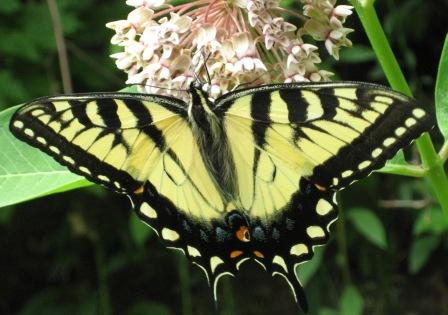
Tiger swallowtail butterfly

Isn’t he gorgeous?

Probably a “he” since the females usually have more blue on their hindwings, according to my butterfly field guide, Butterflies of North America by Jim Brock and Kenn Kaufman.

What’s really interesting, though, is that if you went by the top of the wings (along with the range) you’d assume this is an Eastern Tiger Swallowtail (Papilio glaucus). But if you look at the underside of his wings . . .

Underside of swallowtail wing

. . . it’s not so clear cut.

You see, there’s a Canadian Tiger Swallowtail too (Papilio canadensis), and it has a range that happens to overlap the northern part of New York State.

Marginal band of Canadian tiger swallowtail wing
The two species of butterflies are very similar, but on the Canadian, the yellow marginal band underneath the fore wing is continuous. Like this.

On an Eastern Tiger Swallowtail, that band would be broken — it would look like a series of dots.

But even that’s not the answer. My butterfly was big. Canadian Swallowtails are usually quite a bit smaller than Easterns. And the black stripe on the underside of the butterfly’s hind wing, closest to his body, would be a lot thicker if he were a Canadian.

As it turns out, the guide says differentiating between the two species “can be difficult along the lengthy, narrow strip where their ranges meet . . .” and to make it even more interesting, “some individuals appear intermediate.”

I’d say this is one of those individuals, wouldn’t you?

We saw several other species of butterfly while we were there — it’s a fantastic spot for butterfly watching, since there’s a terrific mix of wetlands and woodlands — but I wasn’t able to get nice photographs of the others.

Unidentified skipper This was the best shot I got of this little guy, which is too bad, because the focus isn’t clear enough and I can’t ID him. I’m guessing it’s some kind of Skipper, but the closest in the guide is a Chisos Banded-Skipper, and they’re described as “rare, found in our area only in oak woodlands of Big Bend National Park, Texas.”
Maybe I’ll try to go back and get another pic. There were two or three of them around. It’s a small butterfly but the banding on the wings was pretty striking.

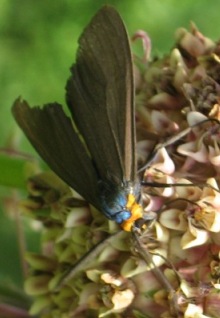
Yellow-collared Scape Moth This isn’t a butterfly, but a Yellow-collared Scape Moth, Cisseps fulvicollis. He’s hit some hard times, judging by how raggedy the back edges of his wings are. These are really common moths around here — you see them all the time on flowers during the day. For some reason I find them just a touch creepy. They look like they’re up to something.
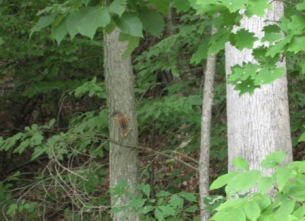
Chipmunk at Mendon Ponds ParkThe park has other critters besides Lepidoptera. There are about a billion chipmunks.
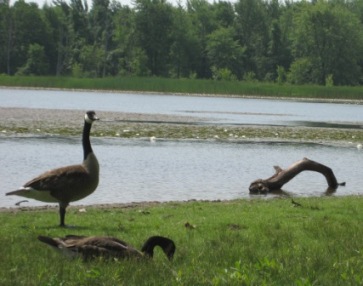
And of course, the requisite Canadian Geese. I liked this shot, only I wish the camera had captured a bit more detail on the head and neck of the goose in the foreground. The shots where I did get more detail, the goose wasn’t posing quite as nicely. Didn’t she know she was supposed to copy the arc of the log in the water? :-)

Canadian Geese at Mondon Ponds Park