Archive for January, 2007

My patio table. That’s a full-size patio table, not one of those wimpy bistro things.

snow table

Snowfall around here was below average in December — waaaay below (total precip was something like 3 or 4 inches, average is 21) but we’re making up for it now.

The Democrat and Chronicle says we passed average snowfall for January last week – and get this — thanks to the jetstream and the Great Lakes snowmaking machine, we could get as much as three more inches a day for the foreseeable future . . .

Yet some people gripe because of a little mud on the golf course!!!

LOL

Technorati Tags: , ,

warm spot

Technorati Tags:

That’s my destination, with a one-day side trip to France, during which time my English friend has admonished me: I’m to let him do all the talking, and forget wearing my cowboy boots or my I heart W tee shirt. Joke, joke, my feet are too wide for pointy-toed boots and my tee shirts are all from Gap.

I leave in two weeks. I’m not taking my laptop; I’ll try to update my blog once or twice while I’m there, and will bring back lots of pics for blogging when I get home :-)

I’m practically beside myself with excitement, so much so that even the threatened series of strikes by British Airways cabin crews has done nothing to dampen my spirits. And n0w I see today there’s been a breakthrough, the first planned strike has been averted. Hooray!

Technorati Tags:

What I’ve been doing instead of blogging :-)

(besides working of course! my day job has been pumping writing assignments to me like an out-of-control gadget in an I Love Lucy bit)

is reading.

Shakespeare: The Biography

One book I’ve just about finished now is Shakespeare: The Biography by Peter Ackroyd, and a couple nights ago got to the chapter covering the period where Shakespeare was writing Coriolanus. One of the themes Ackroyd explores is Shakespeare’s use of contemporary political events in his drama; in Coriolanus, there are parallels between the events of the play and the 1607 Midland uprising by English peasants against the landed gentry. Shakespeare displays an empathy with his characters; for instance, he portrays his rioting Roman citizens as motivated by imminent starvation. Nonetheless, notes Ackroyd, Shakespeare didn’t take a political position in the play. Instead, he “displaced and reordered” the events of his own day “in an immense act of creative endeavor.”

Everything is changed. It is not a question of impartiality, or of refusing to take sides. It is a natural and instinctive process of the imagination. It is not a matter of determining where Shakespeare’s sympathies lie, weighing up the relative merits of the people and the senatorial aristocracy. It is a question of recognising that Shakespeare had no sympathies at all. There is no need to ‘take sides’ when the characters are doing it for you.

To take this a step further, consider Norman Holmes Pearson and W.H. Auden’s introduction to Viking’s The Portable Romantic Poets, in which they write:

Consciousness cannot divide its données into the true and the false, the good and the evil; it can only measure them along a scale of intensity.

Exactly. And so we have in Shakespeare that he seeks the intensity of consciousness rather than, say, ethical illumination; this explains also why “art” in the service of some sort of Message is invariably off-putting, like a note struck not quite in tune; even though we may nod in approval our jaw has tightened slightly; we are burdened by such “art” rather than released.
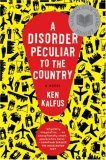
A Disorder Peculiar to the Country

As it happens, I’ve also just finished another book, A Disorder Peculiar to the Country, by Ken Kalfus, which the bookjacket promised to be “rollicking” and “a brilliant new comedy of manners.” The book, if you haven’t heard, is set against the backdrop of 9/11 and its aftermath; the plot is the bitter interplay between a man and wife who are divorcing. It was a 2006 National Book Award Finalist and got press when it was published for having incorporated 9/11, and for the opening hook: both protags believe for a short time that the other had perished that morning, and hate each other so much they both hope it to be true. And so you have the frisson of public horror mixed with private triumph, raising the possibility that the book will somehow conflate or even alchemize public and private worlds, public and private reactions. It’s a book, IOW, that suggests we will find some sort of Meaning, if only of the sardonic sort.

And so I read, hunting. Here’s a bit of what I found: a reference so passing as to almost seem inserted (as if the actual event occurred as Kalfus was drafting the book; it didn’t, it actually happened before 9/11, although in the book, whether by error or literary license, it’s said to have happened in 2002) to a suicide bombing of a pizzeria in Tel Aviv. Marshall is reminded of the bombing when he’s walking in Manhattan and is startled, post-stress-syndrome-traumatically, by the sound of a “heavy steel grille being slammed shut on the back of a truck parked in a loading zone;” he goes on to reflect:

This was a world of heedless materialism, impiety, baseness, and divorce. Sense was not made, this was jihad: the unconnected parts of the world had been brought together and made just.

So Marshall’s personal world is allegorically connected to international events. Nod, nod.

Earlier in the book Joyce, the wife, again in a scene that felt to me patched-in, is said to be “intently” following the invasion of Afghanistan — so much so that she memorizes the country’s geography, the better to follow the military campaign’s every move. She’s also “drawn to the Afghan people, for their beauty and primitive dignity, even if that dignity seemed contradicted by their brutality, untrustworthiness, and venality” and asks

Would American wealth and the expediencies of its foreign policy corrupt the Afghan people? Or were we being corrupted by their demands for cash, their infidelities, and their contempt for democratic ideals?

Meanwhile her life hadn’t changed. She was still not divorced and she had lost hope of ever being divorced; or, more precisely, her marriage was a contest governed by one of Zeno’s paradoxes, in which divorce was approached in half steps and never reached. After the long post-9/11 interregnum, Joyce and Marshall had resumed meeting with the lawyers, who themselves seemed wearied by their disputes despite the cornucopia of billable hours.

You can almost hear the study questions forming in the background. How does the Afghan invasion shed light on Joyce’s behavior toward her husband? Her attitude toward her divorce? How she views herself within her marriage?

And of course there’s also the possibility that we’re intended, as well, to find Kalfus himself peeking through, a kind of parallel world outside the book where he is wink wink nudge nudge “taking sides.” More study questions.

What we don’t find, however, is intensity. There’s the Jerry Springeresque viciousness of Marshall and Joyce’s mutual hatred, but that’s not intensity, that’s spectacle. Certainly neither Marshall nor Joyce “take sides” in contemporaneous political questions, unless moral ambivalence itself counts today as side-taking.

We’re left with mere Meaning.

It’s enough to make one wonder if that’s the most to which a literary writer, writing in America today, can dare aspire.

Technorati Tags:

Via AOL’s new & improved front page interface, I found this story today: four guys building a documentary around the concept of “what’s the one thing you want to do before you die.”

They’ve invited people to contribute to a list of 100 things. Then they help the contributors accomplish their respective goals. Film it, etc. etc.

Here’s the list.

One thing that strikes me is how mundane a lot of the items are. “Plant a tree”? “Take a kid on a toy shopping spree”? Who needs help doing stuff like that? For dog’s sake, people, if “throw a surprise party” or “donate blood” is all that stands between you and a sense of lifelong accomplishment, what are you waiting for?

There are a few items that are a bit meatier, of course. But even some of them are more a question of a little research & planning. “Drive a race car,” for instance. Assuming you’re sound of body, there are car racing training outfits that will deliver you to that dream.

Last category are the “dreams” that require a mix of pluck, work, and an alignment of stars. “Go to space.” “Start a television show.”

Those are the minority. IMHO those are the only sorts of dream that really matter. But I suppose it’s because those are the sorts of ideas that really get me juiced.

So. What’s your dream? What’s the thing that, looking back from your deathbed, you’ll count as the thing that made the difference between a life-well-lived and one not?

And what are you doing about it?

Technorati Tags:

I have just bought a new digital camera. Needed because I wanted something compact to take with me on my trip to London next month.

I debated which brand to go with; after reading a number of praise-filled reviews like this one, I decided on a Canon SD600.

purple fringe

Image quality was the overriding factor, a priority I learned with my last digital camera. The one before it was a Kodak LS443, which I loved. Its replacement, however, burdened me with a couple of irritants. It has a detachable lens cap, instead of a lens cover that opens and closes when you turn the camera on and off. If you forget to remove the cap, it’s catapulted onto the ground when you turn on the camera (by the telescoping of the lens). (The cap has a strap but nothing to attach it to — it’s too short to comfortably reach the hook for the camera’s wrist strap.) Not to mention I’m continually putting it down and then having to remember where I left it.

More damning was the image quality, particularly a color distortion that crops up all too frequently in constrasty images.

Compare that to this, taken with my old LS443:

no purple fringe

When I zoom no this one I can see some very slight fringe where my sister’s teeshirt sleeve is juxtaposed against the lilypads; even at this size you can see a little purplish cast on the shirt itself, but it’s not nearly as pronounced.

I didn’t know this was called purple fringe until I started researching my next camera purchase. Turns out it’s not that uncommon. And while it’s partly due to the properties of light (a messy substance if there ever was one!) “Most of the problems seem to be as a result of individual camera designs.”

So. Here’s a shot out my back door with my old camera this morning:

more purple fringe

I didn’t get a pronounced fringe but you can see the purplish cast. Here’s the same view, with my new Canon:

hardly any purple fringe

Needless to say, I’m thrilled.

Next step: a digital SLR. But that can wait :-)

Technorati Tags: ,

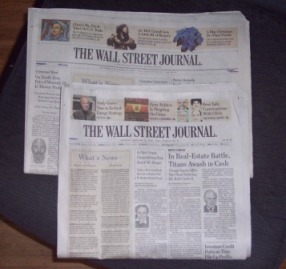
To the Wall Street Journal.

wall street journal

I suppose the new format makes it easier to schlep around, but I feel a sense of loss. The old WSJ had a kind of a grandeur about it. It’s like I went to sleep one night with a ‘55 Cadillac Coupe DeVille in my garage, woke up the next morning and somebody had swapped it out for a little Hyundai or something. An era’s over, without my permission.

(Yeah, I know, newspapers are dinosaurs, etc. etc. I’m the first one to say so. But I didn’t really view the WSJ as a newspaper, more like a daily magazine. And sometimes I like to read hardcopy, maybe because I work at a computer screen all day long.)

If you’re looking for a Serious Article about Serious Writing, here’s a dish served up by the Guardian from U.K. writer Zadie Smith.

Smith starts by asking why it’s so difficult to write a perfect novel. She doesn’t try to define “a perfect novel” however, and right off the bat dismisses critics, falling back instead on an assertion that writers aren’t ever satisfied with their own books, ergo, their books can’t be considered “perfect.” This dissatisfaction, she says, can be traced back to dissatisfaction with one’s ability to fully and truthfully capture “the truth of experience”:

There is a dream that haunts writers: the dream of the perfect novel. It is a dream that causes only chaos and misery. The dream of this perfect novel is really the dream of a perfect revelation of the self. In America, where the self is so neatly wedded to the social, their dream of the perfect novel is called “The Great American Novel” and requires the revelation of the soul of a nation, not just of a man … Still I think the principle is the same: on both sides of the Atlantic we dream of a novel that tells the truth of experience perfectly. Such a revelation is impossible – it will always be a partial vision, and even a partial vision is incredibly hard to achieve-

Hmmmmm.

Obviously this refers to literary novels, since a novel’s entertainment value plays no part in the equation. There’s no room here for the perfect “page turner” ha ha ha, nor for the sort of innocent reading my daughter enjoys, where she loves books for the pure pleasure of being lost in their pages.

Literary novels, on the contrary, are Serious; writing them is no less than a moral act, as per part 2 of the piece:

The chief enemy of excellence in morality (and also in art) is personal fantasy, the tissue of self-aggrandising and consoling wishes and dreams which prevents one from seeing what there is outside one … This is not easy, and requires, in art or morals, a discipline. One might say here that art is an excellent analogy of morals or indeed that it is in this respect a case of morals.

A case of morals. Yeah. “I’m a writer, and I’ve come down with a baaad case of morals.”

Interestingly enough, there’s nothing really about craft in either of these lengthy piece’s two lengthy parts.

Maybe craft is assumed . . .

Technorati Tags:

My friend Dave, publisher of Rochester Health Living, just tipped me to this American Marketing Association (Rochester chapter) blog post. According to the post:

Although this video started as an internal piece, it ended up on YouTube and other websites in December and according to an Advertising Age article is “ranking high on viral-video charts and is garnering big laughs and praise”.

Here’s the vid. Rock on, Kodak :-)

Technorati Tags: , ,

Gee, here’s a surprise. A “consultant report, released Tuesday

recommends city officials abandon a decadelong push to turn High Falls into an entertainment quarter and instead let private investors continue to steer development toward housing and office space . . .

In its report, the Center for Governmental Research concluded that the city should sell off the buildings it owns, halt its operating subsidies and clean up public spaces it has allowed to languish.

No private property remains available for renovation or redevelopment, the report says — thus turning the focus to the city and Rochester Gas and Electric-controlled land and buildings. The city owns the Center at High Falls/Brown’s Race Market complex. RG&E owns the land below the falls, the Beebee plant and other, smaller buildings.

Since 1992, the city has dumped $41 million of our tax money into the High Falls district. The bright idea: subsidize a bunch of bars because, ya know, that would make the place so cool people would flock to it after work, get real smashed, and, uh, revitalize downtown.

The plan was launched during Bill “Fast Ferry” Johnson’s administration.

Creating a housing and office district was the directive from an initial city-commissioned financial and market study in 1990. R. Carlos Carballada, the city’s commissioner for economic development, said that despite the city pushing in another direction, “the market has sort of evolved itself.”

“The market has sort of evolved itself.” Funny thing, that.

Maybe it’s time for our politicians to recognize that they shouldn’t be risking our money in these schemes.

Ah, don’t hold your breath. The next course is already slowly browning in the oven: buying Midtown Plaza, because what else does the city have to do with our money besides develop 1.2 million square feet of abandoned retail space?

(I’m not just being a crank, here, either. Yes, I believe it’s foolish for the city to own hard assets that it has to maintain, at taxpayer expense, for extended periods of time — particularly when local economic conditions suggest the chances of a decent return are not all that great. But I have constructive suggestions, too. I think the city should focus on making our community more livable and affordable for families, as per this post, and perhaps fund events to attract tourists, because that’s been demonstrated as a less risky way to stimulate economic development.)

Technorati Tags: , , ,