Poets & Writers has compiled a list of writing grants and contests that award at least $1000; a list of all the contests with upcoming deadlines; a list of contest winners; and a list of writing conferences.
The banquet begins here.

Poets & Writers has compiled a list of writing grants and contests that award at least $1000; a list of all the contests with upcoming deadlines; a list of contest winners; and a list of writing conferences.
The banquet begins here.
Not recommended you make lemonade, but it turns out there might be some good that can come of it.
Scientists are racing to identify the weird microorganisms growing in Berkeley Pit Lake in Butte, Montana, before it’s cleaned up.
The “lake” was once a copper mine. It filled with water when the mine was closed 24 years ago.
Dissolved metal compounds such as iron pyrites give the lake a pH of 2.5 that makes it impossible for most aquatic life to survive. In 1995 Stierle discovered novel forms of fungi and bacteria in the lake. More recently her team has found a strain of the pithomyces fungi producing a compound that binds to a receptor that causes migraines and could block headaches, while a strain of penicillium fungi makes a different compound that inhibits the growth of lung cancer cells.
This week they reveal that a novel compound called berkelic acid from another new strain of penicillium fungus reduces the rate of ovarian cancer cell growth by 50 per cent (Journal of Organic Chemistry, vol 71, p 5357).
Wild.
Compounds in the leaves of the American beauty berry plant (Callicarpa americana) apparently help ward off biting insects.
Here’s hoping they find a way to turn this into a product. Anything has to be better than citronella spray. Yech.
Speaking of natural remedies, if you apply the juice from jewel weed (Impatiens capensisto) a fresh mosquito bite, it won’t swell up or itch.
I mention jewel weed in my novel.
Dean’s driveway was so narrow that tree branches whipped the side of Maisey’s car as we drove in. I noticed the piles of brush I’d helped him move off of it after the ice storm were half-hidden now by brambles and, in the wetter places, tall pale clumps of jewel weed.

This is fun: The Mississippi Review has published an edition of Freymoir-inspired short stories.
Here’s an excerpt from editor James Whorton Jr.’s intro:
We talk about the various narrative genres — novel, memoir, short story, straight journalism — as though these categories have a separate existence from the particular works they describe. Credibility does not reside in the genre, however, but in the person of the writer. Books don’t lie to us, people do: we’ve been lied to by neighbors, Presidents, and novelists alike, and skepticism will never be made obsolete by any refinement of the literary categories. It will always be indispensable both to citizenship and to literacy.
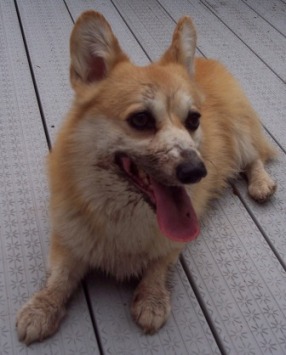
My dog looooooves visiting my parents . . .
Yup, the time has come for high concept plagiarism lawsuits, because that’s where the money is, of course.
Royce Mathew has sued the Walt Disney Co., Buena Vista Home Entertainment, Jerry Bruckheimer Films, Touchstone Home Video and 24 other related enterprises that had a stake in the 2003 blockbuster Pirates of the Caribbean: The Curse of the Black Pearl for copyright infringement.
Mathew claims he’s spent 20 years working on “drawings, screenplays, outlines, blueprints, storyboards, and other original materials” and that he’d filed the lot with the U.S. Copyright Office, to boot. He also claims he’s shown his ideas to Disney people and their cronies, “both privately and through the William Morris Agency and Creative Artists Agency.”
I’m sorry. I realize this may be some poor little fella who’s been slowly draining the very blood of his veins into a creative obsession for his entire adult life (or his golden years, or whatever). But you can’t copyright a creative concept. You just can’t.
If people could copyright creative concepts, we writers would all be doomed. It would be like Internet domain names, a whole mini-industry would spring up aswarm with people copyrighting every conceivable plot line.
So some squatter would own the rights to “girl meets boy, girl denies attraction to boy, girl realizes oops boy is her One and Only” and just like that, every romance/chick lit/commercial women’s fiction writer on the planet would be back to their day jobs.
Via the always worth-the-read Booksquare. With a nod to E is for Editrix, who’s all excited about the eyeliner thing :-)
Update: see also this post on “extreme copyright.”
It poured down rain here in Rochester all day today. I just checked my rain gauge: 3.6 inches!!!
Yikes!
In February, I blogged about Aubrey de Grey, the Brit who thinks science may help us live far longer than we do today.
Other scientists, it turns out, are bothered by de Grey. Gee, what a surprise. It’s another example of how the scientific community, when confronted with new ideas, reacts emotionally instead of rationally — which is not only unseemly, but also a breach of public trust.
The issue in question doesn’t have to be earth-shattering, even — as I posted here, when George Brooks figured out that lactic acid doesn’t cause post-exercise muscle soreness, he was harassed for thirty years: he had trouble getting grants funded or papers published. Over lactic acid. C’mon, guys, RELAX.
In de Grey’s case, the scrapping took an interesting twist last year when Technology Review and de Grey’s charitable foundation, the Methuselah Foundation, put together a $20,000 prize for anyone who could prove that de Grey’s anti-aging prescription was “so wrong that it was unworthy of learned debate.”
Nobody was able to claim the prize, although Technology Review‘s admission of that point is a bit mealy-mouthed:
In the end, the judges felt that no submission met the criterion of the challenge and disproved SENS, although they unanimously agreed that one submission, by Preston W. Estep and his colleagues, was the most eloquent. The judges also noted, however, that de Grey had not convincingly defended SENS and that many of his ideas seemed somewhat fanciful.
LOL
Translation: “nobody came close, but how BEAUTIFULLY written their failed arguments were!!!! And even if they lost, de Grey didn’t win either, so nyah nyah nyah!!!”
Me, I’m not so sure I’d want to live 1000 years, although I’m hoping to beat the actuary tables. OTOH, scientists need to welcome — not just tolerate, but welcome — odd ideas and challenges to their thinking.
Because as I noted in my post about Brooks, the public is poorly served when scientists care more about preserving the status quo than, well, science.
Of the 20-odd agents I’ve queried so far for my current novel, I’ve done only one by mail.
All the rest have been email queries.
I have to believe I’m not the only writer who’s inclined to favor e-querying. It’s cheaper and less trouble than printing and packaging a snail mail query. And you also get answers faster. Granted, most of them will be “no thanks” kind of answers but even they feel good in a weird kind of way. At least you have evidence that things are moving.
But here’s the thing. Many agents — many very good agents — still prefer traditional paper queries.
So I hereby predict that writers who take the time to craft and mail traditional queries will, at some point, have a slight advantage in the agent-hunting game. Because at some point the majority of the great unpubbed will be dashing off e-queries. Which means anyone willing to put in a bit of extra effort and expense will be rewarded with a slightly less-crowded playing field.
I predict you’ll soon be reading writer-advice articles that recommend you seek agents who only accept snail mail queries as a way of boosting your agent-hunting odds.
You read it here, first.
:-)


