Archive for May, 2006

It’s good news. A healing. An unexplicable healing. Even better. And on a night when I’m in an uncommonly delicious mood, too delicious to blog, even. Back tomorrow ;-)

Technorati Tags:

If you’re a writer who has ever submitted anything anywhere, you’ll appreciate this ;-)

Yet another bit of fun linked on Miss Snark.

Technorati Tags: ,

About what you “read in the papers,” that is. You know that Newsweek story from 1986 that said single women over 40 were more likely to be killed by terrorists than find husbands?

It was bunk.

Here, via CJR Daily, is a quick recap of the original piece.

Newsweek’s cover was premised on a single demographic study on marriage patterns in America which included these “dire statistics”: “white, college-educated women born in the mid-’50s who are still single at 30 have only a 20 percent chance of marrying. By the age of 35 the odds drop to 5 percent. Forty-year-olds are more likely to be killed by a terrorist: they have a minuscule 2.6 percent probability of tying the knot” — figures which, Newsweek noted, were creating a “profound crisis of confidence among America’s growing ranks of single women.”

Here’s Newsweek’s mealy-mouthed retraction, 20 years later.

You know what? The 1986 Newsweek article includes all the elements that ought to make one instantly suspicious about a so-called news story– and no, I’m not even talking about the “single demographic study” bit. That’s too easy.

I’m talking about the combination of a hysterical cadence of direly regressive statistics and the assertion that the aforementioned statistics are causing terrible emotional duress–i.e., that they’re already exacting a measurable toll on peoples’ day to day lives.

It’s contemporary journalism’s equivalent of frenzy-inducing demagoguery. It doesn’t have to make sense. All it has to do is tap into some primal fear–fear of being alone, in this case–and ladle on a bunch of numbers that make it look like the reader is doomed.

But it gets worse. Here’s CJR Daily again:

How did that “terrorist” line come to pass? The magazine explains that it was “first hastily written as a funny aside in an internal reporting memo” by a Newsweek correspondent, then “inserted … into the story” by an editor on the opposite coast. Although this editor and her colleagues “thought it was clear the comparison was hyperbole … Most readers missed the joke.”

Not only was this a piss poor piece of journalism–they were flip about it.

Flip. As they launched a meme that, although subsequently debunked, remains widely believed.

Moral of the story: if it reads like hype, it is hype. Ignore it, for the sake of your own mental health.

Technorati Tags: ,

That’s how much of America is lawn, according to Brian Black in CS Monitor. He’s reviewing “American Green: The Obsessive Quest for the Perfect Lawn,” by Ted Steinberg.

Black admits he doesn’t care for lawns, and Steinberg, apparently, thinks they’re “an instrument of planned homogeneity.”

As Americans sought to fit in with one another during the cold war, writes Steinberg, “…what better way to conform than to make your front yard look precisely like Mr. Smith’s next door?”

Sorry, but I think that’s just silly (although not quite as silly as “we descended from savannah dwellers,” lol). If it were true, then we’d all be painting our houses the same color. For that matter, we’d all want houses built exactly alike. We’d demand cookie-cutter landscaping. But we don’t. Even in relatively homogenous tracts, builders know to vary the color, orientation, floor plan etc. of the houses–and the longer they’re lived in, the more we alter them to make them unique.

Lawns are simply a fashion–a landscaping fashion–and like all fashion, the reason they’re popular is esthetic. People like the way they set off our homes and gardens, forming a kind of matte within the frame of road, sidewalk, or property line which borders our homes.

That’s why uniformity (i.e., no weeds) is considered so desirable. We don’t want the matte to call attention to itself. It’s supposed to be even-textured and uniform in color.

Are lawns a good ideal from an environmental standpoint? Probably not. But it’s facile to dismiss them with singsong “they’re all made out of ticky tacky” platitudes, particularly when your platitudes are tinged with condescension. Tastes change, and there’s no reason our collective eye couldn’t begin to appreciate other ways to frame our homes. But the way to get people to change is by presenting alternatives they find beautiful, not sneer at them for being mindless conformists.

Technorati Tags:

And God bless our troops.

Technorati Tags:

Just when you thought one could hardly find a new virtue to ascribe to the blogosphere, we have this, in a piece at 2Blowhards about pulp fiction:

I was brainwashed, er, educated into reading and appreciating upscale fiction, yet my own temperament much prefers popular fiction. Games with words and concepts can amuse me for a while, but on a gut level I love narrative. In this, I’m like most people, of course. It’s funny the degree to which the upscale set has made so many readers feel apologetic about preferring story to intellectual shenanigans and art-games, isn’t it? Story is basic, after all; without it, there’s no such thing as fiction in the first place. Where highfalutin’ artists and audiences often see narrative as a to-be-regretted necessity, I see it as an inviting and giant playground. Where the upscale set often experiences the requirements of story as getting in the way of creativity and visions, I see narrative as what makes expression possible.

I can remember exactly when I realized that for me as a writer, it was about telling stories. I was an undergraduate, a Comparative Literature major, and reading all kinds of High Literature, but on the side I’d begun collecting volumes of folk tales at second hand bookstores, I’d become fascinated with literature’s oral roots, with the image of people gathered around a communal fire, trading stories, and how once in awhile someone would come along who was just that much better at telling them; someone who knew how to embellish an old tale just so, how to draw out the suspense, how to time the climax.

I was a hair’s breadth from becoming an academic, applying to graduate school and embarking on a writing career that would have hinged, always, on writing for other academics. But I broke.

I went for a long time afterward not writing much fiction — too much other stuff to sort out — but my fundamental commitment had been made. I wanted to tell stories. I wanted to write books that people draw up to, transfixed, the way they once listened to storytellers spin tales around those ancient fires.

Do I have the chops? I don’t know. But that’s my aspiration.

I hang out on a chicklit forum on Yahoo (a fabulous resource for anyone who writes commercial women’s fiction) and once every couple of months someone will post a link to yet another review that sniffs at the chicklit genre for not being Literature, for not being High Art.

And every time, I feel like I’m looking at something through the wrong end of a telescope — something far away. And preternaturally tiny . . .

Technorati Tags:

It’s become a cliché to assume that individuals who aspire to perform physically grueling feats somehow embody humankind’s highest ideals. So we rush to applaud people who reach Everest’s summit and hold them up as worthy of our admiration.

Yet, as recent news stories have suggested, people who climb Everest can be a nasty lot. Granted, we don’t know what really transpired up there on the day David Sharp died. There’s been speculation that some 40 people may have passed him, but who knows how many realized he was there or was in trouble. Another key qualifier: of the people who did see him, how many were descending? Climbers can’t carry extra oxygen on these trips, so trying to save him under those circumstances may well have led to additional deaths.

By way of analogy, suppose you and a companion are on a boat, and it capsizes. There are no life preservers. You are a fairly strong swimmer, although not trained in life saving techniques. Your companion, on the other hand, is a poor swimmer, and panics. Every time you try to approach him, he attempts to climb up on you, which pushes you underwater.

At what point do your companion’s actions, even if they are the actions of someone “not in his right mind,” essentially become homicidal?

That said, it seems that at least one party passed him while ascending (I’ll get to that in a minute). So it’s little surprise that people now suspect the “code of ethics” among so-called high-altitude mountaineers is laced with a big dose of “every man for himself.”

And while leaving other climbers to die is the most appalling example of this, it’s not the only one. In another moral compromise, Mt. Everest is also piled high with garbage. The logic is identical to that which dictates dying climbers be left behind: the conditions are so difficult, climbers can’t expend the energy needed to carry out spent oxygen containers, food packaging, or their own bodily waste. So it, too, is abandoned. Garbage now litters the summit and its approaches–as much as 100 tons of it. (I don’t know if that figure includes the 180 frozen bodies of climbers who have died on the slopes.)

Okay, so you have strewn garbage and people left to freeze. What, then, is important to the climbers? How about disrobing on the summit? To “set a record.”

In fact, setting records seems to be what it’s all about. One of the parties that passed the dying Sharp featured a double amputee. He summitted and returned to his New Zealand home to “cheering crowds.”

According to a number of media reports, Inglis’ party passed Sharp on the way up, not the way down. So although he claims Sharp couldn’t have been saved, the fact is if they’d aborted their ascent, they could have used the oxygen allotted for that ascent to keep Sharp alive while trying to get him down.

Instead, Inglis set a record.

Climbing Everest. The new definition of baseness.

Technorati Tags: , ,

A blind tasting of wines first compared 30 years ago was deja vous all over again.

In May 1976, nine French wine experts judged New World cabernet sauvignons and chardonnays against their beloved red Bordeaux and white Burgundies in a blind tasting.

Judges ranked the California wines as superior. The French were shocked.

They were also a tad unsporting about the whole thing. During the tasting

the French judges made now-infamous aspersions about the wines. Comments such as “That is clearly from California!,” when tasting a sub-par French wine, and “OK, back to France!,” when their taste buds were actually craving a California wine, have haunted the French to this day.

The French consoled themselves at the time with a new twist on sour grapes — they said well, okay, maybe, but the California wines surely wouldn’t hold up as well, over time.

But they have. In this new tasting, which included the same wines compared in ‘76, the “top four winners were Californian.”

Ridge Monte Bello 1971, Stag’s Leap Wine Cellars 1973, Heitz Martha’s Vineyard 1970 and Mayacamas 1971 (in a tie), and Clos du Val 1972.

I actually drink a fair amount of French wine, and I delight in finding delicious, modestly-priced French bottles. (I’d delight in the expensive bottles too, if I weren’t on a budget, but that’s a whole other subject.) I’m also enough of a romantic that I’d be heartbroken if the French wine industry ever collapsed.

But I also think it’s silly for the French to think they have a corner on the intelligence, refinement, and commitment to esthetics that it takes to craft fine wines. Obviously, they don’t. And you know what else? That’s okay. Because the fact is, we ought to be celebrating our common culture and heritage and values, rather than projecting our insecurities and letting ourselves be pushed about, pawn-like, by our baser impulses. Don’t you think?

Technorati Tags:

Omg this is funny!

Via Miss Snark . . .

Technorati Tags: , ,

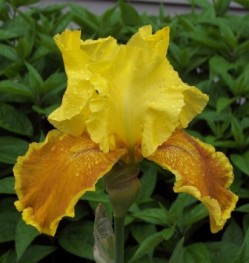
iris

I planted these last year, so this is their first time blooming. I thought they were “Harvest of Memories” — that’s what I’d written in my notes when I was figuring out what varieties to buy and where to put them — but now that they’ve bloomed, I’m confused — I think that the falls on Harvest of Memories are supposed to be the same shade of yellow as the upper petals. As you can see, the falls (lower petals) on these blooms are tan. Did my order get mixed up? Is there some variation in Harvest of Memories colors? Did I actually order something different and neglect to change my notes?

Doesn’t matter, in any case, I like them a lot, whatever they are.

Technorati Tags: ,