There’s spending, and then there’s spending

I don’t consider myself knowledgeable enough about the Monroe County budget to speak to whether there’s any fat that could be trimmed. But when it comes to the national budget, clearly some spending decisions are driven by politicians’ craven attempts to score easy points with their constituents, regardless of whether that spending is good for the nation as a whole. That’s why it’s nice to see that pressure on Congress to reduce porkbarrel spending seems to be working. According to figures published by blogger N.Z. Bear, FY ’07 earmark requests are down 37 percent.

That is very good news.

Locally, perhaps the answer is something along the lines of what Michael Caputo suggests in one of his recent series of stories on the proposed county sales tax hike:

The dire choices presented by Brooks had she opted to cut services. She told the assembled in the County Office Building last Thursday that to cut the programs necessary to balance the books would have been… well, draconian. She talked about ending the road patrol service. She talked about closing the zoo… closing the parks . . .

This is as if she couldn’t scale back on some or all of these programs. Why end them? Why give us the all or nothing scenario? That is, of course, about making a point using drastic means.

Whatever the specific answer, the real takeaway is that if the politicians know people are paying attention, their behavior changes. We have to show them we expect them to act responsibly — that we haven’t forgotten it’s our money they’re spending.

Think about this, the next time a local pol wants to build a parking garage that’s only supposed to last 30 years.

Speaking of organic

Here’s a review of a new book, We Want Real Food, by Graham Harvey, which examines the effect of the depletion of soil nutrients on the nutritional quality of our food.

To some extent, we’re able to compensate by taking vitamin supplements, but as I suggested in this post, that’s not an ideal answer, either. In the long run, we need to convert mainstream agriculture to more organic-style practices. No question about it.

Look, ma, no dandylions

Lawn

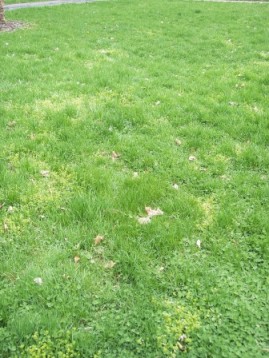
Actually there are a handful — you may be able to make them out toward the top of the photo.

But. There are far fewer than there were last year, which is a reason to celebrate, because this marks the one-year anniversary of my starting a program of organic broadleaf control.

My secret weapon is corn gluten, a byproduct of cornstarch production that acts as a natural pre-emergent herbicide — it inhibits root growth of newly sprouted seeds. (It’s also a 10-0-0 slow release fertilizer.) (I buy it at Bristol’s farm market in Victor.)

In addition to the corn gluten, I set my mower blades pretty high (three inches). The idea is that taller grass is healthier grass — the root system becomes stronger — and healthier grass is able to crowd out other plants. Taller grass also helps the earth retain moisture and prevents light from reaching any weed seeds, which prevents them from germinating. It looks okay, too — when it’s freshly cut it’s nice and neat; you can’t really tell it’s being cut longer unless you walk across it. (Don’t use the photo as the guide on that point — I haven’t mowed yet, this spring.) And it doesn’t mean I have to cut more often, either — leaving it longer doesn’t make it grow faster.

My lawn is a perfect lab for this experiment, since my property’s previous owner never did anything but mow, and until last year, I didn’t either. So that was 15, maybe 20 years of laissez-faire lawn care, plenty of time to establish a nice colony of broadleaf plants: ground ivy, white clover, violets, broad leaf plaintain, speedwell, dandelion, purslane, wild lettuce, dock.

In the photo, you can see clover in the foreground. The lighter-color patches are speedwell, probably slender speedwell, Veronica filiformis. It’s a low-growing plant that tends to spread out in mats. It is more noticeable now than it will be later, because it’s in its first flush of spring growth. Plus the patches are smaller this year than before.

Which means next year they’ll be smaller yet. Or who knows? Gone completely. We”ll see.

What I’m doing, at this point, is waiting out the perennials. Dandelions, for instance, can live five years or so. I have to wait until the established plants have passed on before my lawn will be pretty much dandelion-free.

Speedwell is a nice little plant, actually, with pretty, delicate little flowers. I also like dandelions. But I’m proving a point to anyone in my neighborhood (or elsewhere, for that matter) who thinks they need to hire chemical companies to spray horrible-smelling, toxic, expensive chemicals on their grass.

Corn gluten isn’t outrageously expensive, either. A $30 bag is plenty to treat my front yard. (I don’t bother with the back yard.) I’ve only treated it in the spring although I’ve read somewhere that a second, late summer application is helpful since some weeds germinate in the fall.

You’ll pay more to have an organic lawn care company care for your lawn than a conventional lawn care company, of course.

But if you’re willing to spread the stuff yourself, it’s not a budget-breaker.

Here’s an Organic Gardening magazine article on organic lawn care.

Here’s another, although this one kind of plays up the expense and difficulty. It’s not that complicated, really. I suppose some lawns might be more trouble, if the soil was deficient in specific nutrients or something. But in my case, if I decided to do more, like spread compost, it would be just for the sake of puttering, not because the lawn really seems to need it.

I’ll post another pic after I mow.

Update: and then came the compost …

Neigh!

Was actually three horsemen that rumbled through Rochester, New York, this week. Death (Robert Wegman), Destruction (collapsing parking garage) and Taxes.

I’ve blogged about the first two already. Here’s the third: County Exec Maggie Brooks has proposed a tax increase.

Here’s her op-ed in yesterday’s paper, in which she sets up a straw man (raising property tax) and hails higher sales taxes as the lesser evil.

And here’s today’s Democrat and Chronicle piece — a survey of reactions to the proposed hike from the ‘burbs. An excerpt:

“It will increase the cost of doing the business — and we’re scared of losing business,” said Mike Terrigino, 46, owner of NapaGino’s restaurant at Penn Fair Plaza in Penfield.

About two-thirds of the additional $73 million raised would come from consumers in their daily purchases of everything from meals at a restaurant to appliances for their homes, county officials say. The remainder would be paid by businesses, in the form of a sales tax on such items as office supplies and gasoline to make deliveries.

With customers already watching their spending, Terrigino worries that some might buy less or dine out less often as a result of a sales tax hike.

His expenses will also go up. Terrigino pays a sales tax on everything from take-out containers and napkins to materials for cleaning. As it is, he pays about $300 a month in sales tax on such items.

Michael Caputo has been blogging extensively about this move. Keep scrolling. Here he’s posted a comparison of how much Rochester gets back from the state sales tax pot (more, per capita, than other New York cities).

Here, he’s got some more interesting factoids — including that New York State”has one of the highest combined state/local sales tax rates in the U.S.”

Personally, I don’t see how raising taxes — any taxes — helps our community. OTOH, we’re enmeshed in such a messy situation at the state level that our options truly are limited.

“Whatever she could lay her hands on”

I’m fascinated by the idea of transformation: the idea that a person might be born one thing, and then through intention, will, perhaps practice, become something else.

If it happens at all, true transformation is exceedingly rare, although to appreciate how rare you need to look past appearances. Consider the picture painted by this review of a biography of Ava Gardner (“Ava Gardner: ‘Love is Nothing’,” by Lee Server), online at the Literary Review. Reviewer Frank McLynn writes that Gardner

exemplified the classic rags-to-riches fable. The seventh child of a North Carolina sharecropping tobacco farmer, she was what the unkind describe as poor white trailer trash, with accent and ambitions to match. The height of her aspirations was to be a secretary in New York, but she was ‘discovered’ from a chance snapshot in a photographer’s window and whisked away to Hollywood for the big star build-up, purely on the basis of her looks.

Her physical circumstances were radically altered. Yet if you read on in the article, you learn that Gardner lived the sort of chaotic, alcohol-sodden life that you can glimpse by flicking on an episode of Cops. The changes to her life were purely superficial.

A contemporary with a somewhat similar experience is Archie Leach — aka Cary Grant. Like Gardner, Grant was born into near-poverty, went to Hollywood, and assumed a life of wealth and glamour. As part of his apparent transformation, Grant changed his name as well as his accent. But was he really transformed? I don’t know. But he seems to have had doubts himself; he’s quoted as saying, “I have spent the greater part of my life fluctuating between Archie Leach and Cary Grant, unsure of each, suspecting each.”

McLynn concludes his piece on Gardner:

As she herself often admitted, she was at root a simple country girl, with a country girl’s values and attitudes, pitchforked into a world of unreality simply because of her beauty. She grabbed whatever she could lay her hands on, and after all who could blame her?

I can’t blame anyone for grabbing what is handed them. But I also can’t give up the idea that there should be more — that as self-aware beings we should be doing more than reacting to what happens to us.

Assuming, of course, that the alternative is even possible.

City living

Here’s an interesting article in New Scientist about an emerging subspecialty in behaviorism/evolutionary biology: how animals adapt when they move into urban areas.

I blogged about urban coyotes here, with a link to an article that briefly discusses how coyote behavior is different in urban environments than rural ones.

It’s an area that will yield a lot of surprising insights in the future, I predict.

When people were cat food

Here’s an interesting piece in The Chronicle Review by anthropologist Donna Hart, who surveys the evidence and makes the claim that early man was mostly prey, not predator. She writes:

Large-scale, systematic hunting of big herbivores for meat may not have occurred any earlier than 60,000 years ago — over six million years after the first hominids evolved.

Meanwhile, we were being hunted by a variety of toothy critters.

My study of predation found that 178 species of predatory animals included primates in their diets. The predators ranged from tiny but fierce birds to 500-pound crocodiles, with a little of almost everything in between: tigers, lions, leopards, jaguars, jackals, hyenas, genets, civets, mongooses, Komodo dragons, pythons, eagles, hawks, owls, and even toucans.

Toucans. Our ancestors were eaten by toucans. I’ll never look at Froot Loops the same way again . . .

Rochester parking garage collapse

This is bad news. Two ramps of the South Avenue Parking garage collapsed yesterday.

Rochester blogger Chuck Simmins was in the garage a few minutes before it happened and has a photo on his blog, here.

The Democrat and Chronicle write-up gave a hint as to the “why’s:”

The city-owned garage opened in 1974 and has been undergoing about $6 million in repairs for more than a year.

In a February 2004 document from then-Mayor William Johnson to City Council proposing $5 million in renovations, Johnson said the garage “has surpassed its original life expectancy and is deteriorating.”

The ongoing repairs, however, “did not include the ramp, but rather areas adjacent to it,” according to City Communications Director Gary Walker.

Nobody was injured in the collapse (miraculously, considering it happened shortly after five on a weekday) but this is going to be a mess that keeps on messing things up for a long time. Not only will it create a downtown parking problem, but they’re going to have to figure out why it collapsed and whether the rest of the garage is structurally sound or not. Mayor Duffy is quoted in the D&C article as saying he’ll need “an awful lot of convincing” to reopen the garage in the future. Yeah, well I’d need an awful lot of convincing to use it in the future . . .

Oh, and btw. How is it that we have municipal buildings that only last thirty years? Is that normal for parking garages, I wonder?

Update: an engineering consulting firm, Stantec Consulting Group, had raised concerns to the city about “deteriorating conditions…”


Robert Wegman R.I.P.

Passed away yesterday at Strong Memorial. Age 87.

If you’re not from the Rochester area and have never been in a Wegman’s supermarket, this Washington Post article (registration required) provides a little background on who this guy was and what he accomplished:

Wegman took over as president of the 90-year-old business begun by his father and uncle in 1950 and over decades introduced private-label products and laser scanning at the checkout.

He was behind the “Shoppers Club” electronic discount program and Wegmans’ “Strive for 5” program offering recipes with nutritional analyses that emphasized fresh vegetables and fruits.

He is credited with pioneering one-stop shopping, placing bakeries, imported foods and cafes into huge stores, along with photo labs, video departments and child play centers.

The 70 Wegmans emporiums in five states employ more than 35,000 people and posted sales of $3.8 billion in 2005.

The company’s employee scholarships, high-end wages and health insurance program have landed Wegmans on Fortune magazine’s list of the “100 Best Companies to Work For” for nine straight years.

In 2005, Wegmans was ranked No. 1 on the list, leading the chairman to say, “This is the culmination of my life’s work.”

When most people think of Rochester corporations, they think of Kodak, which hasn’t exactly had a pleasant time of it over the past decade. Wegman’s, on the other hand, has flourished, growing into a local icon that rivals Kodak in many ways.

I mean, unless you’ve been to one of these stores this will sound totally ridiculous — but if you were to come from out of town to see me, a flagship Wegman’s is one of the tourist stops we’d visit.

Other bloggers’ thoughts (some of which are posted by people who had met him or worked for him) here, here, here, here, here, and here.

The man was deeply admired and even loved . . .