
Archive for April, 2006

My dad maintains bluebird houses on his property, so he doesn’t like House Wrens, and I can’t blame him. They’re an aggressive little bird; they’ll go so far as to destroy the eggs of other birds nesting in their territory. Perhaps this is why they are also a successful little bird. According to Cornell University, they have “one of the most extensive ranges of any bird in terms of latitude.”

My suburban home isn’t bluebird habitat, however, so I’m glad to have wrens about. It’s partly nostalgia — wrens used to nest under the eves of the cottage where spent summers with my grandparents, on Cayuga Lake. And it’s partly because hanging a wren box is all but guaranteed to attract a House Wren — they’re so common, and they seem to like being around people. The name “House Wren,” in fact, derives from their tendency to nest near human houses.

So I’ve hung a nestbox in the flowering crabapple in the backyard, and every year a pair settles in to raise a family.

I heard one sing for the first time this year, a couple of days ago, and managed to get a photo of him yesterday.
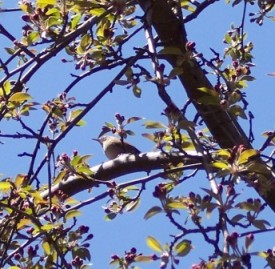
wren

The best way to identify wrens (other than their song, which I’ll get to in a sec) is their profile, particularly their tail, which they carry pointed upward at a feisty angle. Their plumage, otoh, is an unremarkable, dull brown, making the females a stand-in for modesty, as in the verse “When Jenny Wren Was Young” from The Real Mother Goose:

‘Twas once upon a time, when Jenny Wren was young,
So daintily she danced and so prettily she sung,
Robin Redbreast lost his heart, for he was a gallant bird.
So he doffed his hat to Jenny Wren, requesting to be heard.

“Oh, dearest Jenny Wren, if you will but be mine,
You shall feed on cherry pie and drink new currant wine,
I’ll dress you like a goldfinch or any peacock gay,
So, dearest Jen, if you’ll be mine, let us appoint the day.”

Jenny blushed behind her fan and thus declared her mind:
“Since, dearest Bob, I love you well, I’ll take your offer kind.
Cherry pie is very nice and so is currant wine,
But I must wear my plain brown gown and never go too fine.”

Perhaps Jenny Wren’s suitability as wife to the more stylish English Robin is related to her royal lineage: the wren is considered King of the Birds. It’s a title won by trickery, however. When the birds decided the one who could fly the highest would be their king, the wren hid itself in the feathers of an Eagle. The Eagle flew as high as it could, and then the well-rested wren emerged and flew yet higher, winning the crown.

A darker bit of Old World folklore is the hunting of the wren:

Down to the present time the ‘hunting of the wren’ still takes place in parts of Leinster and Connaught (in Ireland). On Christmas Day or St Stephen’s Day the boys hunt and kill the wren, fasten it to the middle of a mass of holly and ivy on the top of a broomstick, and on St Stephen’s Day (26 December) go about with it from house to house, singing: “The wren, the wren, the king of all birds,/St Stephen’s Day was caught in the furze;/Although he is little, his family’s great,/I pray you, good landlady, give us a treat.” Money or food (bread, butter, eggs, etc.) were given them, upon which they feasted in the evening’ (Golden Bough, 1 vol. ed. Macmillan, 1963 (originally 1922), pp. 536-7). – In England such rituals died out in the nineteenth century, but the song survived.

The origins of the ritual aren’t clear — Wikipedia mentions a tradition that Saint Stephen was betrayed by a wren, but the scholarship in the piece linked above suggests it predates Christianity.

Here in North America, the wren’s significance is considerably more prosaic: when the wrens have returned, you know it’s truly spring.

You can’t miss a wren’s song, either. It’s distinctive (my grandfather called it a “bubble de bubble”) and delightful, and also loud — Native Americans called the House Wren “o-du-na-mis-sug-ud-da-we-shi, (making a big noise for its size)” (although apparently it plays second fiddle to its close relative, the Winter Wren, which has the distinction of a song with “10 times more power than a crowing rooster” ).

Yep, you can’t miss them.

And now they’re back. There’s still time, too, if you want to enjoy wrens around your house this year. You can find wren houses in hardware and big box building supply chains — they’re the small, cheap ones ;-)

Meanwhile, here’s a Cornell web page on house wrens, including a wav file of its song so you can hear that bubble de bubble for yourself.
Technorati Tags:

I have several perennial beds on my property, one of which is in the front yard. A big challenge, with this garden, is the timing of the plants’ blooming. I have a lot of flowers (crysanthemum, perennial sunflower, and aster family plants) that bloom in late summer. But the rest of the year there have been occasional “gaps” when nothing is blooming.

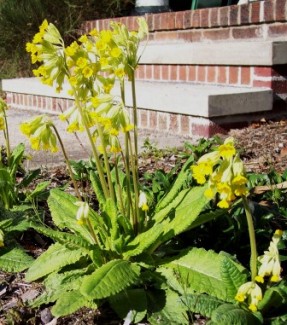
One of these gaps falls in late April/early May. So last year I bought some primula veris — a non-hybrid primrose — and I’m very pleased with the effect.

primroses

The plants are 12-14 inches high, and the blooms have lasted for weeks — they first started to put out their bloom stalks the first week of April.

The size of the bloom clusters, their height, and the intensity of the color makes them visible from the street, which is part of the spec. They also work with the palette I’ve got going in this garden, which is primarily whites and yellows, deepening into some oranges/corals as accents.

I bought the primroses last spring from Evermay nursery in Maine, which specializes in primroses. I had a great experience with Evermay and highly recommend them.

In fact, one of the nicest things about the Internet is that small, specialty growers can reach a bigger mail order market. They get more customers. We get access to a wider variety of interesting plants.

I’ll post more when some of my other experiments bloom :-)

Technorati Tags: , ,

Chuck Simmons has more pics up of the Rochester parking garage that collapsed a week ago.

Technorati Tags:

Hi! I’m popping up to grab a bit of fresh air and blink in the light.

I’ve been following links from links on this Kaavya Viswanathan story.

I started with this blog, The Analytical Knife, and followed a link there to Lizzie Skurnick, fisking a Harvard Independent article based on an interview they did with her.

Skurnick also put up a link to this Slate ariticle by John Barlow, about his short stint as a book packager writer-for-hire.

I made a couple of side-trips on the way, but you’ll have to find them for yourself.

I think I need a rest now. Good stuff tho, all of it.

Technorati Tags:

Booksquare has a post up about the Kaavya Viswanathan plagiarism scandal that raises the question behind the question:

It also makes one wonder why in the world a business like Little, Brown would spend a reported $500,000 on an unwritten book by a first-time author who was starting her academic career at a famously tough university.

For a possible answer, Booksquare links to this piece at Publisher’s Weekly that suggests How Opal Mehta Got Kissed, Got Wild and Got a Life was purchased not as a novel, but as a product: an attractive author with an interesting backstory, matched up with a “test-marketed, packaged” story.

Makes sense to me.

Technorati Tags: , ,

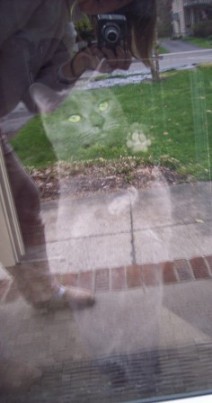
cat reflection

My camera’s autofocus did this. I didn’t.

He’s indoors — behind the glass. The autofocus trained in on the reflection on the glass.

Technorati Tags:

Project Implicit is an online timed “Implicit Associaton Test” that lets you compare your conscious preferences to what they call “automatic” preferences — preferences of which you are not conscious.

The IAT was originally developed as a device for exploring the unconscious roots of thinking and feeling. This web site has been constructed for a different purpose — to offer the IAT to interested individuals as a tool to gain greater awareness about their own unconscious preferences and beliefs.

It works by flashing words at you; you assign the words to categories. Some of the words are obviously positive or negative. Some of the words are not. The test is looking for when you “accidentally” miscategorize a word. It’s kind of like inducing Freudian slips.

The topic of each session is assigned randomly. I got “coffee vs. tea.” My test results read:

Your data suggest a strong automatic preference for Tea compared to Coffee.

That’s news to me.

I drink a cup of coffee every morning . I often drink a cup of tea in the afternoon. I enjoy my afternoon tea — I view it as a treat. But I don’t look forward to it with the same, ahem, intensity that I seek my morning coffee.

OTOH, I’ve been exposed to a lot of claims that tea is the more healthful drink, and perhaps my ambivalence about my coffee dependency bled through a bit. Plus I’m, ahem, something of an Anglophile. For a variety of reasons, some too delicate to mention. So maybe that’s skewed me toward the cuppa . . . still, “strong preference”? That’s pretty . . . strong.

The test has been used to identify more controversial “automatic preferences,” including detecting unconscious racism. Is it valid for such applications? I don’t know.

If you try it, drop a note in the comments about your experience, or blog about it and I’ll link back to you.

Technorati Tags: ,

Common-Place, an online publication by The American Antiquarian Society, has done a special issue on money. It’s a treasure trove. Take a look when you’ve got a bit of time and want a long, rich read.

Technorati Tags: ,

Hop over to the The Daily Puppy — they’ve got the cutest little bulldog mug posted this morning!

Technorati Tags:

Damn Interesting has a piece up about nanobatteries (with a clever ending, ha ha ha) that concludes they are “still too expensive or impractical to be put to everyday use.”

Here’s another interesting development in battery design (Wall Street Journal article so subscription required):

Dr. [Angela] Belcher, a materials scientist at the Massachusetts Institute of Technology, heads a team that has successfully created a battery assembled by a benign biological virus that binds to gold and cobalt oxide.

The new material “has three times the electricity-generating capacity of traditional battery materials of the same size” and will enable batteries smaller than hearing aid batteries.

But that’s not all. Get a load of this:

Besides high power, the technology promises batteries that are flexible and transparent. That raises the possibility that a small portable video screen — such as the one on a cellphone — could be coated with the viral-battery material instead of being attached to a separate battery. Other applications might involve medical use such as battery power for tiny devices threaded through arteries.

A tiny, clear battery. Just don’t drop it.

Or mix it up with your contacts.

Here’s the MIT press release on the new battery material.

Technorati Tags: ,